Americans struggled to process what is real, trustworthy and authentic as the unraveling of deep political decay revealed a behind-the-scenes subterranean power struggle that has surfaced with the intent on disintegration of American Society

If given the choice between maintaining a toxic world of fear, pollution and violence controlled by the State or a society of prosperity and compassion based on freedom and individual rights, there is little doubt that the majority of Americans would want the old paradigm of synthetic events to take a hike; except that choice has been distorted under the guise of what the World Health Organization (WHO) has mislabeled the most deadly virus in history.

The coronavirus crisis arrived in a flash with little time to analyze exactly WTF was going on. Americans struggled to process what is real, trustworthy and authentic as the unraveling of deep political decay revealed a behind-the-scenes subterranean power struggle that has surfaced with the intent on disintegration of American Society.

While the country is fast approaching an existential crisis on steroids, millions experienced an inner knowing that some indefinable thing was not right with recognition that the early explanations were hogwash while others, addicted to mainstream/social media who still believed in the illusion of democracy, were on board with the litany of spin from the medical and political establishment.

While the Lockdown could have been a wake up call for humanity to change its consciousness with a paradigm shift – whether it be a spiritual awakening, a political realignment or re-evaluating one’s own personal health choices, since, after all, humanity was locked in a major health crisis. And most importantly, it was an opportunity to acknowledge that the planet itself is ailing from abuse and neglect with CV as a metaphor urging a personal reconnection with Nature.

In early 2020, Neil Ferguson of the UK’s Imperial College used a scare tactic to predict that 80% of Americans would be infected and that there would be 2.2 million American deaths – neither of which materialized. Yet Ferguson’s extremism accomplished its intended purpose in establishing the basis for draconian Lockdown requirements. Ferguson later retracted his earlier prediction down to 20,000 fatalities.

With current infection fatality rate at 0.20%, Lockdowns have been devoid of science and are based on arbitrary, contradictory and inconsistent requirements.
Nancy
Just a few examples come to mind, such as liquor stores and big chains are considered ‘essential’ and remain open but stand-alone, independent, mom ‘n pops are not. Barbers may be open but hair salons may not. While it is advised to get tested for Covid19, a colonoscopy or other elective surgery are not allowed. While vitamins C and D and Sunshine strengthen the immune system, all outdoor sport programs have been canceled.

In an unexpected development, a recent JP Morgan study asserted that the Lockdowns failed to “alter the course of the pandemic” as it “destroyed millions of livelihoods” and that as infection rates ‘unrelated to often inconsistent lockdown’ measures decreased, fewer outbreaks were reported as the quarantines were lifted.

As the official narrative of the Covid19 as an existential threat has collapsed, it is interesting to follow how ‘hot spots’ occur just as a particular State, like Florida, announces re-opening.

Those new hot spots encourage a reinvigorated debate over mandatory face masks and social distancing with its success depending on a duplicitous media instilling panic and a naive public still believing Covid19 to be more dangerous than seasonal flu.

WHY LOCKDOWN ASYMPTOMATIC CITIZENS?

Dr. Maria Van Kerkhove, technical lead of WHO’s COVID19 Task Force threw a monkey wrench in the works recently by stating:

what we really want to focus on.. if we followed all the symptomatic cases, isolate those cases, follow those contacts and quarantine those contacts, we would drastically reduce..transmission. We would do very, very well…”

Dr. Van Kerkhove then explained that transmission of the virus from asymptomatic patients appears to be very rare:

It still seems to be rare that an asymptomatic person actually transmits onward to a secondary individual.”

The next day, there was panic at the WHO but Dr. Van Kerkhove’s uncensored comments were very clear as they validated questioning the purpose of the entire Lockdown process. If an asymptomatic person is not spreading the disease but might publicly increase herd immunity, then why wear a face mask or be quarantined?

House Speaker Pelosi called for a national mask mandate as HHS Secretary Azar reported that Pence and Trump are tested daily and are asymptomatic; therefore not required to wear a mask.

WHY FACE MASKS?

To date, there is no standard for what constitutes a ‘safe’ face mask or instructions for disposal considering that a used face mask will be a contaminated bio-hazard material; ergo a face mask is more of a device to require citizen compliance than a safety precaution.

Adding a partisan narrative to the crisis, the most expansive lockdown restrictions (some with criminal penalties) came from predominantly Democratic Governors and Mayors who offered no science or forensic data to prove that either mandatory face masks or home sequestration have failed to prevent a spread of the virus.

During a House Oversight committee meeting, the mask debate broke down along party lines with Dems dutifully covered while strenuously objecting to their mask-free peers.

A riveting June 23rd Palm Beach County Commission public hearing on a proposed Mandatory Face Mask ordinance drew overwhelming opposition.

While OSHA’s (Occupational Safety and Health Agency) responsibility is to oversee the health and safety of every American worker as each workplace is expected to comply with OSHA standards, its website regarding COVID19 states that cloth-based face masks

will not protect the wearer against airborne transmissible infectious agents due to loose fit and lack of seal or inadequate filtration.“

OSHA goes on to inform that a safe level of oxygen must be maintained as an oxygen deficient atmosphere (defined as below 19.5% by volume) creates a respiratory risk.

While there is no sound science or evidence to prove the benefits of mandatory usage, the NE Journal of Medicine reported that:

We know that wearing a mask outside health care facilities offers little, if any, protection from infection […] The chance of catching Covid-19 from a passing interaction in a public space is therefore minimal. In many cases, the desire for widespread masking is a reflexive reaction to anxiety over the pandemic.”

More recently, NIAID Director Dr. Anthony Fauci declared masks as largely ‘symbolic’ as he was setting an example for what other people should be doing.

There’s also a “Risk of Hypoxia to All Mask Wearers” according to Drs. Russell Blaylock and Zach Bush.

SOCIAL DISTANCING AKA QUARANTINE

With not a whit of science in support, Social Distancing which is a mutually exclusive phrase since there is nothing social about enforced distancing from other humans, has been attributed to a CIA protocol in use since the 1950’s to break a prisoner’s resistance or a teenage science project.

In any case, SD has proven a great way to erode an individual’s normal need for social contact, to effectively starve the brain function of human interaction and comparable to other emotionally unhealthy deprivations. As former Vietnam POW John McCain related “It crushes your spirit more effectively than any other form of mistreatment.”

Rules 3 and 44 of the Nelson Mandela Rules warn of being cut off from the outside world and prohibits more than two weeks of isolation as cruel and inhumane treatment.

*

While the manufactured COVID 19 health crisis opened the door for the World Economic Forum and its friends to activate One World Government, millions of Americans continue to play the cognitive dissonance game with little awareness they are witnessing a government takeover with increased surveillance and censorship. As coordinated violent protests in Seattle and DC spread a thinly veiled political coup, all accomplished more easily while the American public were in Lockdown.

“Tsunami of Job Losses”: U.S. Economy Hasn’t Experienced Anything Like This Since the 1930s Great Depression

The recession of 2008 and 2009 was bad, but it was nothing like this.  Even though this new economic downturn is only a few months old, we are already seeing numbers that we haven’t seen since the worst parts of the Great Depression of the 1930s. 

More than 48 million Americans have filed new claims for unemployment benefits over the past 15 weeks, well over 100,000 businesses have permanently closed their doors, and civil unrest has turned quite a few of our major cities into war zones

But not all areas of the country are being affected equally.  For example, there are rural areas that haven’t really seen a lot of COVID-19 cases where life seems to have changed very little from six months ago.  On the other hand, some urban areas that have been hit really hard by COVID-19 have been absolutely devastated economically.  For example, the New York Times is reporting that a million jobs have been lost in New York City, and the unemployment rate for NYC “is hovering near 20 percent”

The city is staggering toward reopening with some workers back at their desks or behind cash registers, and on Monday, it began a new phase, allowing personal-care services like nail salons and some outdoor recreation to resume. Even so, the city’s unemployment rate is hovering near 20 percent — a figure not seen since the Great Depression.

We are going to be using the phrase “since the Great Depression” a lot in the coming months.

Fear of COVID-19 is going to paralyze our economy for the foreseeable future, and all of this fear is hitting some companies more severely than others.  On Tuesday, Levi Strauss announced that sales were down a whopping 62 percent during the second quarter

The denim maker Levi Strauss & Co.’s sales fell 62% during its fiscal second quarter, the company announced Tuesday, as its online sales weren’t enough to make up for its stores being temporarily shut for roughly 10 weeks during the Covid-19 crisis.

If Levi Strauss expected this to be just a temporary setback, they would probably try to keep all of their employees on board.

But instead, they apparently believe that hard times are here to stay and they have just decided to eliminate “about 700 jobs”

Levi’s also announced it will be slashing about 15% of its global corporate workforce, impacting about 700 jobs, in a bid to cut costs during the coronavirus pandemic. It said the move should generate annualized savings for Levi’s of $100 million.

Of course a whole lot of other companies are laying off workers right now too.  Another 1.427 million Americans filed new claims for unemployment benefits last week, and that is an absolutely catastrophic number.  Prior to 2020, the worst week in all of U.S. history for new unemployment claims was in 1982 when 695,000 unemployed workers filed in a single week.  So what we are witnessing right now is nothing short of a “tsunami of job losses”, and even CNN is admitting that millions of the jobs that have been lost “are never coming back”…

The American economy’s unprecedented jobs rebound masks a difficult truth: For millions of people, the jobs they lost are never coming back.

“It’s clear that the pandemic is doing some fundamental damage to the job market,” said Mark Zandi, chief economist for Moody’s Analytics. “A lot of the jobs lost aren’t coming back any time soon. The idea that the economy is going to snap back to where it was before the pandemic is clearly not going to happen.”

I couldn’t have said it better myself.

Since most Americans were living paycheck to paycheck before this pandemic erupted, millions of unemployed workers have found themselves in desperate need very suddenly.  I have written numerous articles about the massive lines that we have been witnessing at food banks around the nation, and we just witnessed another two mile long line at a food bank in Florida

More than 700 cars were seen waiting in a two-mile long food bank line in Florida as the US grapples with nearly half of Americans being unemployed amid a spike in new coronavirus cases that has sparked fears of more shut downs and lay-offs.

Sunrise Assistant Leisure Services Director Maria Little, who was put in charge of food distribution for the city when the coronavirus hit the US in March, said her group served about 720 cars in Miami on Wednesday.

This is not what a “recovery” looks like.

In fact, for certain sectors of the economy the numbers are rapidly getting a lot worse.  For instance, just check out what CNBC is reporting

Delinquencies in commercial mortgage-backed securities last month had their largest one-month surge since Fitch Ratings began tracking the metric nearly 16 years ago.

The delinquency rate hit 3.59% in June, an increase from 1.46% in May. New delinquencies totaled $10.8 billion in June, raising the total delinquent pool to $17.2 billion.

And Fitch Ratings is warning that these numbers are going to get far worse in the months ahead.

And this is just the beginning. Fitch analysts are projecting that the impact from the coronavirus pandemic will drive the delinquency rate to between 8.25% and 8.75% by the end of the third quarter of this year.

I have said this before, and I will say it again.

We are on the verge of the biggest commercial mortgage meltdown in the history of the United States.

Countless restaurants and retailers are getting way behind on their rent payments, and as a result many owners of commercial property are finding it increasingly difficult to make their mortgage payments.

The dominoes are starting to fall, and this is going to get really, really messy as we head into 2021 and beyond.

Of course the same thing could be said for the U.S. economy as a whole.

I know that I haven’t been posting quite as often the last couple of weeks, and that is because I have been finishing my new book.  It is not too far from being completed, and it is going to be the most important thing that I have written so far.

We are right on the precipice of the most chaotic chapter in all of American history, and a collapsing economy is just going to be one element of “the perfect storm” that we are facing.

So please use the summer months to get prepared for what is ahead, because even though things are bad right now, the truth is that we have only experienced the leading edge of “the perfect storm” so far.

The US is currently experiencing what might be called a ‘triple crisis’. A health crisis that shows little sign of abating. A deep economic crisis that is still in its early phases. And a ripening political crisis

The reopening of the US economy in June—and some states as early as May—has produced a modest economic ‘rebound’. But rebound is not to be confused with economic recovery.

The current rebound is the natural result of the US economy collapsing 40% between March and June 2020. In the first quarter, January-March 2020, the US economy contracted 5%, virtually all of that in March. While the final data for the 2nd quarter is yet to be announced, the US Federal Reserve Bank’s forecasts of US Gross Domestic Product (GDP) show a much greater collapse, ranging from -30.5% (NY Fed district) to -41.7% (Atlanta Fed district).  No economy can continue to collapse at that steep a rate quarter after quarter.

Economies experiencing deep and rapid contractions—which is typical of both great recessions and economic depressions—inevitably experience periods of leveling off for a time, or even a slight bounce back—i.e. a rebound. But that’s not a recovery. ‘Recovery’ means a sustained, quarter to subsequent quarter economic growth that a continues more or less unabated until the lost economic ground is ‘recovered’. But a rebound is typically temporary, followed by subsequent economic relapses in the form of stagnant growth or even second or third dip recessions.

Look at the Great Recession 1.0 that began in December 2007. The decline began that month subsequently declined more rapidly in the first quarter 2008, but then bounced back slightly in the 2nd quarter 2008. It then took a deep dive in the second half of 2008 through the first half of 2009, contracting every quarter for an entire year. A short, shallow recovery followed into 2010. But the economy relapsed again in 2011, contracting once more for two quarters in 2011. Another small rebound followed in early 2012 and was followed by stagnation in the second half of 2012.

The reported GDP numbers after 2008 were even weaker, and the relapses more pronounced, before the US Commerce Dept. changed the way it defined US GDP and boosted the totals by $500 billion a year after 2013, retroactive to 2008 and before.

All Great Recessions with an initial deep economic contraction, are typically followed by brief shallow recoveries, cut short by subsequent double dips or quarters of no growth stagnation.

That was true of the Great Recession of 2008-09, which didn’t really end in June 2009, but bounced along the bottom economically for several more years. A similar trajectory will almost certainly follow today’s 2020 Great Recession 2.0 now concluding its Phase One initial deep collapse.

The Phase One deep collapse is now giving way to its Phase Two and what will prove a brief and quite modest ‘rebound’. But that’s not a recovery.

Further economic relapses are inevitable after ‘short, shallow rebounds’ that characterize all Great Recessions. That trajectory—i.e. short, shallow rebounds followed by relapses also brief and moderate can go on for years.

What it means is there will be no V-shape and true recovery in the US economy in the second half of 2020. What there will be is an extended ‘W-shape’ period, the next two years 2020-2022 at minimum. And it may continue for perhaps even longer.

The 1929-30 Great Recession: Anteroom to 1930s Depression

A similar scenario occurs prior to bona fide economic depressions, like that which occurred in the 1930s.  The great depression began initially as a Great Recession. US policy makers failed to contain it and it slipped into the Great Depression of that decade as we know it. What precipitates Great Recessions collapsing into bona fide Depressions is the collapse of the financial and banking system.

The Great Depression of the 1930s did not begin with the stock market crash of October 1929, however. The real economy was already slipping into recession in manufacturing and construction sectors in 1929, well before the October 1929 stock market financial crash.  The economy contracted in 1930 by -8.5% and continued to contract every year thereafter through mid-1933 as the US economy experienced a series of four banking crashes, one each year from 1930 through 1933. The banking crashes drove the real, non-financial economy ever deeper every year, in a ratchet like effect.

Rebound and growth followed 1934-36. However, that weakened significantly in late 1937 as a conservative Republican Congress and Supreme Court together began dismantling Roosevelt’s 1935-37 New Deal social spending fiscal stimulus programs. As a result, in 1938 the US economy fell back into depression once again. A partial reversing of the dismantling in 1939 produced a return to positive GDP growth that year. But it wasn’t really until 1941-42 that the economy really exited the Great Depression, as US GDP rose 17.7% in 1941 and then 18.9% in 1942. Recovery—not rebound—was clearly underway after m id-1940—i.e. the result of government spending on both social programs and defense that amounted to more than 40% of GDP those years. That was fiscal stimulus. That was recovery.

In other words, the lesson of the Great Depression of the 1930s is in order to end a depression, or stop a Great Recession from becoming a Depression, the government must step in and spend at a rate of 40% GDP.

Prior to the onset of the current 2020 Great Recession 2.0, the US government’s spending and share of US GDP was about 20%.  It needs to double to 40% to engineer a true recovery from the current crisis.  5.5% is no stimulus in fact; just a partial ‘mitigation’ of the severe collapse that just occurred. That is, a temporary floor under the deep 30%-40% collapse that would have been even greater.

The 2008-09 Great Recession: The 5.5% Failed Stimulus

In January 2009 the incoming Obama administration proposed a fiscal stimulus recovery package amounting to roughly $787 billion and 5.5% of GDP. Economists advocated double that. Even Democrat party leaders in the US House proposed another $120 billion in consumer tax cuts. But Obama’s economic advisers, mostly former bankers and pro-banker academics like Larry Summers, argued the US could not spend that much. Obama listened to Summers and reduced the amount to the $787 billion.  It proved grossly insufficient. The real economy continued to lag and job losses continued to mount. Supplemental programs like ‘cash for clunkers’ and ‘first time homebuyers’ had to be added.

Even with these post-January program supplemental spending Obama’s fiscal stimulus proved insufficient to generate a robust recovery, as the historical record shows. The US recession under Obama ‘recovered’ at its weakest rate compared to all the prior ten US post-recession recoveries since 1947. The Obama recovery was only 60% of normal for recession recoveries.

The problem with the Obama 5.5% was not only the insufficient magnitude of the stimulus. Its composition was deficient as well. It called for almost $300 billion of the $787 billion in mostly business tax cuts, which were then hoarded by business and not invested to expand output, hire more workers, and generate thereby more income for consumption.  Nearly $300 more was in the form of grants given to the states to spend. They too hoarded most of it and failed to rehire the unemployed as was intended. The remainder of the $787 billion was composed mostly of long term infrastructure investment and spending that had little initial effect on the economy’s recovery. As a result of the insufficient magnitude and poor composition of the Obama 2009 stimulus, the US economy fell into a ‘stop-go, W-shape economic recovery for the next six years. US jobs lost in 2008-09 were not recovered until as late as 2015, and the average wages paid for the new jobs was significantly less than wages paid for the jobs that were lost.

Another major contributing factor to the weak economic recovery under Obama was the agreement between Obama, US House Democrats and the Republican Senate in August 2011 to reduce spending on education and other programs by $1.5 trillion. Thus the $787B stimulus of 2009 was reversed by more than twice, as austerity was introduced in late 2011. More than twice what was injected into the economy in 2009 was taken out again starting in 2012. The inadequate less than $1trillion fiscal stimulus was over in just two years!

The point is: apart from the matter of austerity in 2011, if 5.5% was insufficient to generate sustained recovery in 2009, today in 2020 the 5.5% fiscal spending produced by the CARES ACT in March 2020 will prove even less successful.

The US economy’s economic collapse today is five times deeper than in 2008-09 and has occurred in one-fifth the time of the 2008-09 event. If a second more aggressive government spending program does not follow in the second half of 2020, then the current tepid economic ‘rebound’ underway due to the reopening of the US economy will certainly fail at generating a sustained recovery. Here’s why the CARES ACT—the main and only stimulus program to date—is only 5.5% and will fail to generate a sustained recovery as the economy reopens with a modest ‘rebound’.

The March 2020 CARES ACT: Failed Stimulus Déjà vu

As of mid-year 2020 the US government spending to date is summed up in the various provisions of the CARES ACT passed by Congress in March 2020, plus several smaller measures passed before and after it as supplements. Its actual spending as of late June 2020 amounts to only approximately a 5.5% contribution to US GDP.

The CARES ACT on paper called for $1.45 trillion in loans and grants to small, medium and large businesses. $500 billion is allocated as loans to large corporations. Another $600 billion to medium sized plus some other measures. And $350 billion in loans, convertible to grants, to small businesses called the Payroll Protection Program, or PPP.

Another $310 billion was added to the PPP small business loan program as banks quickly misdirected hundreds of billions of dollars to many of their ineligible bigger business prime customers which scooped up much of the original $350 billion for small business.

The three business programs combined thus allocated $1.76 trillion in loans and grants.

Another $500 billion was allocated to workers and US households in the form of supplemental income checks of $1200 per adult plus an extra $600 in federal unemployment benefits available through July 31, 2020.

A couple hundred billion dollars more went to hospitals and health care providers in emergency reimbursements before and after the March CARES ACT passage.

That brought the total March CARES ACT fiscal stimulus to roughly $2.3 trillion. However, not discussed much in the media is another $650 billion CARES ACT provided business and investor tax cuts. The tax cuts include a temporary suspension of business payments to the payroll tax; more generous net operating loss (NOL) corporate tax averaging that allows business to use current losses to get tax refunds on prior year taxes paid; faster depreciation write-offs ( de facto tax cut); and more generous business expense deductions.  Less than 3% of the $650 billion tax cuts in the CARES ACT went to families earning less than $100,000 per year in annual income.

On paper, the roughly $2.3 trillion CARES ACT amounted to roughly 11% of GDP. But only half of that 11%–or just 5.5—has actually hit the US economy. This contrasts with Germany and other European and Asian countries that boosted fiscal spending stimulus by as much as 15%-20%.

Another 5.5% Stimulus Means Another Failed Sustained Recovery

The 5.5% to not enough to kick start the rebound into a sustained recovery. Much of the 5.5% is already spent to mitigate the 2nd quarter deep contraction and is no longer available as a stimulus in the upcoming 3rd quarter.

All the $1200 checks have been spent already and most of the $600 unemployment benefit boost has entered the economy. The latter expires on July 31. Furthermore, the majority of the $1.7 trillion allocated to businesses large and small has yet to get into the US economy as well.

Of the $660 billion in the small business PPP program, about $520 billion has been spent. Less than $100 billion of the $500 allocated to large businesses, like airlines and defense companies, has actually been ‘borrowed’ by big business. And as mid-June 2020, none of the $600 billion for medium size businesses had yet been ‘taken up’ by those businesses. The program was only fully launched late June, more than three months after it was first announced in March.

Thus far little interest appears on the part of medium and large businesses in the more than $1 trillion loans allocated to them.  And as far as the $650 billion in tax cuts is concerned, its effects can be delayed until December 31, 2020, if even then. Given the weak US economy and consumer demand, many businesses will take the tax cuts and hoard them.

In short, more than half the roughly $3 trillion total of government spending, loans, grants and tax cuts provided by the CARES ACT is yet to be committed to the US economy. The official 11% is really only half that at best.

This fact leads to the interesting question: Why have medium and large businesses not take up more of the $1.1 trillion business loans allocated to them?

The $3+ Trillion Uncommitted Business Cash Hoard

The answer is they haven’t because they are already bloated with cash and don’t need or want it. That cash hoard has resulted from several sources in recent months: Large corporations saw the writing on the wall with regard to the virus as early as January-February 2020. They quickly began loading up on cash by drawing down their generous loan credit lines with their banks. That produced a couple hundred billion dollars in cash by March. Then they issued record levels of new corporate bonds to raise still more cash. From March to end of May more than $1.3 trillion in new corporate investment grade bonds was raised by the Fortune 500 US businesses—i.e. more than in all 2019. A couple hundred billion dollars more was raised in junk grade corporate bonds.

Still another cash source was raised by businesses suspending dividend payments and stock buybacks to shareholders. In 2019 they distributed $1.3 trillion in buybacks and dividend payouts

($3.4 trillion total under Trump’s first three years in office). So buybacks and dividends suspensions saved at least another $500 billion in cash.  Companies also began selling off and cashing in their minority stock interests in other companies.  Furloughing workers to work from home also saved still more cash in reduced facilities, benefits and related costs for many corporations. Tech companies especially benefited from this.

Bloated with trillions of dollars of cash, large and medium sized corporations had little interest in borrowing from the CARES ACT, since the latter came with conditions like the provision that 70% of the loans be spent on keeping workers on their payrolls.  They preferred to lay off their workers, and borrow from the credit markets, issue new bonds, and otherwise conserve cash.

A good example was Boeing Corporation. Congress allocated more than $50 billion to Boeing as part of the $500 billion loan program earmarked for large corporations. Instead of borrowing that, Boeing raised $25 billion issuing new bonds and announced layoffs of 16,000 of its workers! Less than $100 billion has been used to date by large corporations under the CARES ACT big corporations’ $500 billion loan allocation. And virtually nothing of the $600 billion to date allocated under the medium size business loan program called the ‘Main St.’ lending facility.

7 More Reasons Why ‘Rebound’ Won’t Mean Recovery

Here are some seven other reasons—apart from the US current insufficient fiscal stimulus—why the US economy will not experience a sustained ‘recovery’ in the next six months, and why instead the US will follow a W-Shape trajectory of weak un-sustained growth followed by economic relapses through 2020-21 (and perhaps even longer):

 1) 2nd Covid-19 Wave Economic Impact:

It is inevitable a number of states will reinstate shutdowns—in significant part if not totally—as the infection, hospitalization, and death rates rise over the summer due to premature reopening of the economy and a growing breakdown of social discipline in adhering to basic precautions like social distancing and mask wearing.  The partial shutdowns will. To varying degrees, reduce consumer spending, business investment, and result in re-layoffs of workers. Second wave layoffs in services like leisure & hospitality, bars, restaurants, travel, public entertainment, and even education and health care services will emerge—all negatively impacting household consumption demand.  It is estimated that at least half of the states, 40% of the reopened economy, will reinstate some degree of re-closures of business activity in coming weeks and months as a resurgence of Covid 19 impacts the US economy in the second half of 2020 and beyond.

The official US June employment report on July 3, 2020 showed 4.8 million jobs were reinstated. But no less than 3 million of that 4.8 million were recalls in leisure & hospitality, hotels, bars, restaurants, and retail industries. These are the same industries that will be affected most by states reinstituting shutdowns. They are also industries where businesses that have been able to reopen only partially thus far in most cases operate on very thin margins. They are likely to fail in Phase Two of the crisis now beginning, and many closing completely in the second half of 2020 as a result of operating only at half capacity.

The scope of the possible closures is revealed by the recent Yelp survey of 175,000 of its customer business base. During the 2ndquarter, Yelp’s survey found that in May-June only 30,000 of its 175,000 had reopened. More important, its survey showed that 40,000 of its 145,000 that hadn’t yet opened had already closed permanently. The wave of permanent business closures in the second half of 2020—especially in the leisure & hospitality and retail industries—should not be underestimated. The permanent shutdowns will occur not only due to reduced consumer demand, but to a resurgence of Covid-19 and a second wave of layoffs.

2) Deeply Entrenched Business & Consumer Negative Expectations

The US economy has been deeply wounded by the deep contraction of the past four months. Both businesses and consumers have negative expectations as to the direction of the economy in the short to intermediate run. Businesses don’t see the conditions for returning to expanding investment, or even returning to prior levels of production and output. With consumer demand clearly in retreat, business expectations of future sales and profits are dampened. Reducing the cost of investing by lowering business taxes or interest rates have little effect on generating more investment, when expectations of profitability—which is what really drives investment—are so low. This is the fundamental reason why business across the board is hoarding its accumulated cash.  The same applies to consumers and households. They too are hoarding what cash they have available, spending mostly on necessities only.  The evidence is the sharp rise in the household savings rate and bank deposit rates. As much cash is saved and deposited as a precaution that economic conditions may worsen, instead of actually spent. The result is only minimal increase in spending occurs, just as minimal investment.  Until negative expectations are somehow reversed, both business investment and household consumption do not rise to levels that result in sustained ‘recovery’.

It will take a major event to again shift business and consumer negative expectations, like a vaccine for the virus or a major fiscal stimulus or a program of mass hiring of the unemployed by government. However, none of the above is on the immediate horizon. Therefore negative expectations will continue to dampen any sustained recovery and limit whatever insufficient government fiscal stimulus to generating a modest ‘rebound’ at best.

3) Business Cost Cutting & Permanent Layoffs

The deep and rapid rate of contraction of the economy over the past four months, and the business expectation of weak recovery, has convinced many businesses to make many of the cost cutting moves of recent months permanent. An example is how some industries and businesses moved their workforces to work from home. It has saved them significant costs of operation—on facilities, maintenance, and some employee benefits. In recessions businesses always find new ways to cut costs that often result in more layoffs and lower wages. Another phenomenon is rehiring and recalling workers back to work temporarily laid off does not occur en masse and all at once. The typical business practice is to recall only part of their workforce and to recall workers more on a part time basis. Not least, the cost cutting and the part time recalls typically results in businesses leaving part of their furloughed work force behind, whose unemployment then becomes permanent.

This second wave of jobless is already beginning to emerge, as businesses downsize in employment after the initial shock to the economy that has already occurred. Airlines are announcing tens of thousands of layoffs. Several other industries are experiencing growing defaults on debt payments and bankruptcies that will result in mass layoffs as well. For example, the oil & energy sector which was a major source of new job creation during the fracking boom of the past five years. More than 200 defaults of companies are in progress. Layoffs are beginning, of a permanent nature not just temporary furloughs or layoffs.

Cost cutting and layoffs translate into less household income for consumption and therefore for generating a sustained recovery.

4) Deeper Global Recession & Global Trade Crisis

The collapse of the US economy in the first half of 2020 has been accompanied by a synchronized contraction of the global economy.  Global economic contraction means US production for export does not recover much in the short run. Offshore demand for US goods & services remains weak. That in turn dampens domestic US investment, employment, and therefore business-consumer spending. Although the US economy is relatively less dependent on exports to stimulate economic growth, exports are not an insignificant contributing factor to US growth and recovery.

More than 90% of the world economy has also experienced deep recession in the first half of 2020. That compares with the first Great Recession of 2008-09 when a fewer 60% of countries were in recession along with the US. Foreign demand for US exports is thus even weaker this time around. Post 2009 China and emerging market economies boomed after 2010 and put a partial floor under US economic contraction by stimulating demand for US product exports; that China-Emerging Market economies stimulus effect on the US economy no longer exists in 2020.

5) Intensifying US Political Instability

One should not underestimate the potential growing political instability in the USA in the second half of 2020.  This instability will occur on two ‘fronts’. One is at the level of political institutions. It is likely the upcoming national elections on November 3, 2020 will be challenged and not accepted by either Trump or the Democratic Party nominee. The growing social instability in the USA and Covid 19 effects on voter turnout, combined with the already widespread voter suppression in various states, makes for ripe conditions for post-electoral crisis should the election be narrowly decided by voters in November.  Evidence is growing, moreover, that Trump is prepared to declare voting by mail as fraud and use that as an excuse to throw the election into the Supreme Court—as occurred in the US in 2000.  Today Trump, unlike George W. Bush in 2000, enjoys an even firmer majority in the US Supreme Court.

The instability at the level of political institutions in the USA today is accompanied by what appears as growing grass roots civilian conflicts. Street level confrontations between Trump supporters and rising popular movements and demonstrations are not beyond the realm of possibility, perhaps even likelihood.

The political instability has significant potential to negatively impact both consumer and business expectations and therefore dampen both business investment and household consumption even further in addition to causes already noted.

6) Wild Card #1: Financial Crisis 2021

Intermediate term, in 2021 likely more than in 2020, is the wild card of a financial system crisis emerging that would exacerbate the real economy’s faltering recovery still further. This channel by which a financial crisis might emerge is a growing wave of corporate and state & local government defaults. Massive excess debt has built up over the past decade in business sectors in the US.  More than $10 trillion in corporate bond debt exists at present. At least $5 trillion in corporate junk bonds and virtual junk like BBB investment grade. Still more for corporate ‘junk’ leveraged loans. A protracted period of recession and weak recovery will generate a major potential for corporate defaults and bankruptcies. If the magnitude and rate of defaults is too great, or comes too fast, the banking system could very well experience a major credit crash once again.

Industries highly unstable with high cost unaffordable debt, and with insufficient revenues with which to service that debt, include: oil fracking and coal, big box retail, smaller regional airlines, rental car and other travel related companies, hotels and resorts, malls, commercial property in general, and hundreds of thousands of small restaurants and regional restaurant chains. Defaults have already begun rising rapidly in many.  Household debt and state and local government debt finds itself in much of a similar situation—highly leveraged with debt amidst collapsing incomes to service the debt as unemployment and wage incomes continue to decline and as tax revenues remain depressed long term due to the weak economic recovery.

The US central bank, the Federal Reserve, is in the midst of an historic experiment to pre-bail out non-bank corporations to forestall the defaults and to flood, at the same time, the US banking system with massive excess liquidity with which to manage the defaults should they come excessively and too rapidly.  It remains to be seen whether the Fed’s massive liquidity injections thus far ($3 trillion), and promised (unlimited), will prove sufficient to manage the defaults.  If not, the US banking system will freeze up as financial institutions begin to crash as well with the transfer of defaulted corporate debt on to their own bank balance sheets.

In 2008-09 it was the banking system that collapsed first and in turn precipitated a deeper and faster contraction of the real economy in the US. Today it is quite possible the reverse causation may occur in the Great Recession of 2020. But it matters not in a Great Recession which precipitates which first—i.e. the banking system the real economy or vice-versa. The key point is that both cycles—financial and real—feed back on the other in a Great Recession and amplify the downturn in both.

7) Wild Card #2: Artificial Intelligence Faster Rollout

Another wild card that may emerge with fuller force longer term is the penetration of Artificial Intelligence in business operations.  McKinsey Consultants estimated that by 2025 AI would accelerate in its penetration of business practices. By the latter half of the 2020s decade it would have deep and widespread impact on employment and wages, as AI led to deep cost cutting by business. As much as 30% of occupations would be seriously impacted. The essence of AI is to eliminate simple decision making jobs, in services as well as manufacturing.

But it is highly possible that AI will now penetrate even faster, accelerated by business cost cutting and productivity enhancing drives, as a consequence of the current deep economic crisis.  The deeper and more protracted the current recession, the more likely business will engage in multiple ways to reduce costs as a means to weather the crisis. AI offers businesses a prime opportunity to do just that. But AI also means a significant reduction in net jobs, especially simple low paid service and retail work. And with the net jobs and wage loss come reduced consumer household demand, consumption, and therefore sustainable economic recovery.

The Case for 40% Government Share of GDP

As previously noted, recoveries from great recessions and depressions require at least a 40% US government spending share of total GDP. Obama’s raised the US government share of GDP to barely 25%, not 40%. The economy accordingly struggled after 2009.

The current 2nd Great Recession 2020, the first phase of which has just concluded in June, is following the same rough trajectory and scenario as the 2008-09. There has been only token fiscal stimulus to the economy thus far from the CARES ACT. Indeed, Congress never considered, at least in the House of Representatives, the CARES ACT was a stimulus bill. It was called a ‘mitigation’ bill, designed to put a partial floor under the collapse of the economy going on at the time in the 2nd quarter 2020. A true stimulus bill was to follow. That’s the HEROES ACT now blocked in Congress by Republican Senate and Trump. What the latter want is to end the unemployment benefits and provide no further income supplement payments. They want to exchange further unemployment benefits for direct wage subsidies to businesses. They want even more tax cuts for business—permanent payroll tax cuts, more capital gains tax cuts, and more business expense deductions. And they are reluctant to provide funding support for state and local governments with accelerating deficits as a result of tax revenue collapse. Should support for state and local governments not occur soon, it is likely mass layoffs will emerge in states and local governments soon.

However, it does not appear so far that anything resembling a real stimulus will get passed with the HEROES Act. The unemployment benefits extension will likely be eliminated. More business tax cuts, should they be added to the $650 billion provided by the CARES ACT, will be hoarded in large part. As will corporate income that would have been otherwise used to pay wages, as the government pays the wages of their workers instead.

An insufficient fiscal stimulus from an eventual HEROES Act, should it occur, will ensure the current tepid ‘rebound’ of the US economy will fail to evolve into a sustained recovery of the US economy. The seven other, additional factors noted above will further prevent a sustained recovery—and indeed may precipitate a subsequent further serious economic contraction. The summer of 2020 is thus a critical juncture period for the US economy.

The US is currently experiencing what might be called a ‘triple crisis’. A health crisis that shows little sign of abating. A deep economic crisis that is still in its early phases. And a ripening political crisis. Never before in its history have three such major events converged. The one of the three that is potentially most manageable is the economic. Health crisis depends heavily on the development of a vaccine. Not much can be done to prevent a deepening political crisis. It will run its course, whatever that may be. But a government fiscal stimulus equivalent to about 40% of US GDP would very likely stabilize the economy and set it on a path to sustained recovery.  However, it is highly unlikely that in the current political climate of instability, deep splits within the US political elites, growing grass roots social confrontations, and failure to mount an effective strategy to address the Covid-19 health crisis that the capitalists and their political representatives will be capable of introducing the necessary 40% war time economic stimulus.
The Impacts of the Draconian Lockdowns: 1.1 Billion People At Risk of Starvation

Leading epidemiologist Dr. John Ioannidis of Stanford University estimates that about 150-300 million or more people have already been infected by COVID-19 around the world, far more than the 10 million documented cases.

In an interview with Greek Reporter, the Greek American scientist warns, however, that the draconian lockdowns imposed in many countries may have the opposite effect of what was intended. “Globally, the lockdown measures have increased the number of people at risk of starvation to 1.1 billion, and they are putting at risk millions of lives,” he says.

It was just three months ago, soon after the onset of the coronavirus outbreak in the US, when Dr. Ioannidis wrote an article for the journal STAT excoriating the US and other countries for not conducting enough testing, and deploring how little real evidence there was of true infection rates, which he feared might soar and create widespread societal unrest.

Now, after the world has experienced approximately 490,000 deaths from the virus, Greek Reporter contacted Dr. Ioannidis to ask the professor for his opinion on several points he made in his March 17th article, and what he has observed in the fight against the virus as it has progressed around the globe.

I think you already know the answer to this, our government is preparing for a crisis – A MAJOR CRISIS
So make sure you watch this presentation while it’s still online…

bnr

Greek Reporter: You stated at that time, when everything seemed so very uncertain, that the evidence at that point for the number of actual infections was “utterly unreliable” and that the “vast majority” of infections were being missed. How do you think the US and other countries have progressed since then in pinning down the actual numbers of those suffering from the virus? You had said at that time “no countries have reliable data on the prevalence of the virus in a representative, random sample of the general population.” Do you still believe that is true? Which countries have performed the best in this regard?

Dr. Ioannidis:  We have learned a lot within a short period of time about the prevalence of the infection worldwide. There are already more than 50 studies that have presented results on how many people in different countries and locations have developed antibodies to the virus. These numbers are anywhere between 5 times (e.g. Gangelt in Germany) and 600 times (e.g. Japan) more compared to the documented cases, depending on whether a lot or limited testing was already performed in different locations. We know that the prevalence of the infection varies tremendously across countries, but also within countries, within states, and even within population groups in the same location. COVID-19 attacks some disadvantaged and deprived communities (harder), and disadvantage and deprivation means different things in different countries. Of course none of these studies are perfect, but cumulatively they provide useful composite evidence. A very crude estimate might suggest that about 150-300 million or more people have already been infected around the world, far more than the 10 million documented cases. It could even be substantially larger, if antibodies do not develop in a large share of people who get through the infection without symptoms or sparse symptoms.

Greek Reporter: What about the 3.4 % death rate projected by the WHO at that time? What do you think it truly is at this point? At the time you had said that the population-wide Covid-19 case fatality rate of .05% was lower than that of influenza. Earlier you had also said that “reasonable estimates for the case fatality ratio for the general population vary from .05% to 1%.” (This seemed to be based on the rather small example of the Diamond Princess cruise outbreak, but that was basically all you had to work from at that point.)

Dr. Ioannidis: 0.05% to 1% is a reasonable range for what the data tell us now for the infection fatality rate, with a median of about 0.25%. The death rate in a given country depends a lot on the age-structure, who are the people infected, and how they are managed. For people younger than 45, the infection fatality rate is almost 0%. For 45 to 70, it is probably about 0.05-0.3%. For those above 70, it escalates substantially, to 1% or higher for those over 85. For frail, debilitated elderly people with multiple health problems who are infected in nursing homes, it can go up to 25% during major outbreaks in these facilities.

Greek Reporter: Are all the current figures being skewed by the complication that some jurisdictions are recording that people died OF Covid-19 when in reality they died WITH it? You had said on March 17, and this still gets lost in the noise of all the events that have taken place in these last turbulent months, that “a positive test for coronavirus does not mean necessarily that this virus is always primarily responsible for a patient’s demise”.

Dr. Ioannidis: This is still a major challenge. COVID-19 has become a notifiable disease so it is readily recorded in death certificates. What we do know, however, is that the vast majority of people who die with a COVID-19 label have at least one and typically many other comorbidities. This means that often they have other reasons that would lead them to death. The relative contribution of COVID-19 needs very careful audit and evaluation of medical records.

Greek Reporter: There is a huge amount of uncertainty each and every year just in the number of influenza deaths, and despite what you called the “successful surveillance systems” which have “long existed for influenza, the disease is confirmed in a laboratory in a tiny minority of cases.” Is this also true with Covid-19, where many people were no doubt infected and suffered only mild symptoms, thinking it was just the regular annual flu — perhaps even before January, 2020, when the disease officially landed on our shores? You gave the range then as differing a multiple of 2.5 times in trying to estimate how many people actually die every year from influenza.

Dr. Ioannidis: As above, the number of people infected with COVID-19 is far larger from the documented cases. The number of COVID-19 deaths can be both undercounted and overcounted, and the relative ratio of over- and under-counting varies across different locations. In most European countries and the USA it is more likely to be overcounted, especially if we are talking about “deaths by COVID-19”. For influenza we have a long-standing experience and the number of deaths can also be fairly well approximated based on the excess number of deaths that we record every winter, as the influenza wave sweeps around the world. For COVID-19 we are in early days, and we need to be careful to dissociate deaths from COVID-19 versus deaths that happened because of the disruption induced by lockdown.

Even SWAT Teams are Helpless Against This – WATCH THIS VIDEO and you will find many interesting things!

Greek Reporter: You had earlier extrapolated 10,000 total US deaths using the Diamond Princess cruise ship analysis, using the case fatality rate among those infected, which was .3% (mid-range guess), with 1% of the US population becoming infected.  As we know now, the total amount of those dying with the disease was much higher but it was still not the astronomical, exponentially huge number that some had predicted. There had been only 68 American deaths by March 16, the day before your original article was published. The most pessimistic projection in March was 40 million deaths globally — the same as the 1918 flu. What do you really think it is now, bottom line?

Dr. Ioannidis: In the STAT article, I discussed two hypothetical extremes for illustrative purposes, one with just 10,000 deaths in the USA and another with 50 million deaths worldwide. I said that our data are so unreliable that the truth could be anywhere between these two amazingly different extremes. Based on what we know now, we seem to be closer to the optimistic end of the range. In terms of numbers of lives lost, so far the COVID-19 impact is about 1% of the 1918 influenza. In terms of quality-adjusted person-years lost, the impact of COVID-19 is about 0.1% of 1918 influenza, since the 1918 influenza killed mostly young healthy people (average age 28), while the average age of death with COVID-19 is 80 years, with several comorbidities.

Greek Reporter: We had been told that we needed to “flatten the curve” — and we did so in the US, did we not? No health system was completely overwhelmed, not even in NYC, where they did not completely run out of ventilators.

Dr. Ioannidis: The predictions of most mathematical models in terms of how many beds and how many ICU beds would be required were astronomically wrong. Indeed, the health system was not overrun in any location in the USA, although several hospitals were stressed. Conversely, the health care system was severely damaged in many places because of the measures taken.

Greek Reporter: Finally, you had stated in March that, regarding lockdowns, they may be “bearable for a time, but how can policymakers tell if they are doing more good than harm?” if they are protracted. “School closures,” you stated, ”may reduce transmission rates” but may also “diminish the chances of developing herd immunity.” Even more important, perhaps, is this point you made — “One of the bottom lines is that we don’t know how long social distancing measures and lockdowns can be maintained without major consequences to the economy, society and mental health.

“Unpredictable evolutions may ensue, including financial crisis, unrest, civil strife, war and a meltdown of the social fabric.” Your thoughts, please, on how many of these things have indeed come to pass in this country as you had feared.

Dr. Ioannidis: I feel extremely sad that my predictions were verified. “Major consequences on the economy, society and mental health” have already occurred. I hope they are reversible, and this depends to a large extent on whether we can avoid prolonging the draconian lockdowns and manage to deal with COVID-19 in a smart, precision-risk targeted approach, rather than blindly shutting down everything. Similarly, we have already started to see the consequences of “financial crisis, unrest, and civil strife.” I hope it is not followed by “war and meltdown of the social fabric.”

Globally, the lockdown measures have increased the number of people at risk of starvation to 1.1 billion, and they are putting at risk millions of lives, with the potential resurgence of tuberculosis, childhood diseases like measles where vaccination programs are disrupted, and malaria. I hope that policymakers look at the big picture of all the potential problems and not only on the very important, but relatively thin slice of evidence that is COVID-19.

The Lost Ways is a far–reaching book with chapters ranging from simple things like making tasty bark-bread-like people did when there was no food-to building a traditional backyard smokehouse… and many, many, many more!

How did the World go Crazy? Who Decided the Lockdown? Who Justified It? Who Thought It Up?

Total Lockdown of the Population: History, Analysis and Prospects

This is now recognized by all those who have the courage to face facts. I will not enumerate in this article the immense body of evidence that exists. All of you have probably done, are doing, or will do your own research. I will only quote a report that was issued by the German Department of Interior: 

“The corona virus is a global false alarm. The danger of the virus has been overestimated (no more than 250,000 deaths worldwide with Covid-19, compared to 1.5 million for the 2017-18 seasonal flu)“.

Yet, the purpose of this article is not to focus on this topic. Like many others, during the last two months, I gathered enough information that allowed me to understand how serious was this “pandemic.”

So, let’s start with this question: If the lethal pandemic  is neither lethal nor pandemic, then why the need for a global lockdown?

Incompetence? Blindness? Conspiracy?

It’s important to answer this question thoroughly by using a fact-based approach. How did the world go crazy? Who decided the lockdown? Who justified it? Who thought it up?

Let’s start with the last question. To my knowledge, no medical textbook has ever recommended quarantining healthy populations, let alone entire countries. It has neither been practiced nor recommended. This idea comes out of a military mindset…

In 2005, under the aegis of Donald Rumsfeld, head of the Pentagon under Bush Jr., Dr. Hatchett, current CEO of the Coalition for Epidemic Preparedness Innovations (CEPI), created a plan for the total containment of the American population in the event of a bio-terrorist attack.

This idea was then reshaped by the Rockefeller Foundation think-tank in 2010. It issued a document called “Scenarios for the Future of Technology and International Development.” One of the four scenarios depicted a global authoritarian containment that could last 10 to 20 years due to a pandemic; this scenario was shown as an imminent possibility for humanity.

So, who did imagine this containment policy? The military and “philanthropists.” No scientists. No doctors.

Now let’s take a look at who did justify and advocate for this containment.

But first, it is important to find out more about Neil Fergusson, the director of the Scientific Advisory Group for Emergencies (SAGE) in the United Kingdom. In 2002, he calculated that the mad cow disease would kill about 50,000 British people and another 150,000 once it was transmitted to sheep. There were only 177 deaths. In 2005, he predicted that the bird flu would kill 65,000 Britons. The total was 457 deaths.

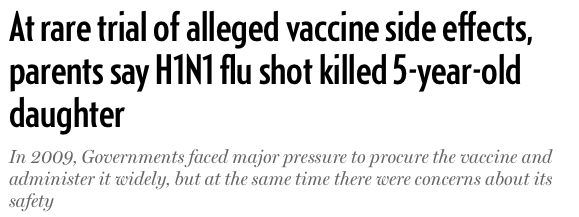
Another important player in this game is the World Health Organization (WHO). In 2009, it issued the H1N1-flu pandemic warning, triggering the purchase of millions and millions of vaccines by governments ($10 a dose). The pandemic never happened. These expensive vaccines were destroyed because they were unused. In addition, these vaccines contained mercury, which created many cases of chronic narcolepsy and other health problems among those vaccinated, including children. Yet, no government ever complained officially to the organization for the “ill-advice” that cost them billions, nor did anyone asked anything from the pharmaceutical companies that produced the toxic vaccine.

In March this year, the WHO launched its ‘Pandemic!’ cry, despite the fact that the number of cases and deaths was much lower than that of the seasonal flu. The WHO was assisted by the unreliable virological tests used worldwide.

Neil Fergusson, on the other hand, true to his alarmist mindset, predicted with his “mathematical model” that 550,000 British people would die from Covid, as well as more than 2 million Americans, if a fierce lockdown did not come into effect. Shortly before, he had shared the same figures with President Macron. Overnight, Great Britain implemented Dr. Hatchett’s plan (CEPI), as many countries had done before. Total lockdown. It didn’t matter that the SAGE revised its numbers sharply downwards afterwards, or that Fergusson was fired. WHO, SAGE and CEPI have justified the containment in front of the closed eyes of the world.

An interesting detail: Who do you think is the very generous funder of these three institutions with their sexy acronyms? Bill Gates.

Incompetence? Blindness? Conspiracy? Coincidence?

We now know who devised the containment, who justified it and who applied it. But there remains one fundamental question.

Why did people accept it without flinching (at least at first)? The answer lies in four letters: FEAR.

A fear skillfully orchestrated by the main-stream media, with its wonderful harmoniously tuned choir. By the way, who is the generous philanthropist who gave millions of dollars to the most important European’s newspapers? Bill Gates, again. But let’s not get ourselves lost in details, and let’s go back to fear. First of all, fear of what? Fear of dying, of course! Without this fear, nothing would have been possible. Fear has paralyzed many thinkers… Fear… We’ll get back to that.

And so, the picture is getting more complete. As in a theatre play, now we can present the characters…

“Lockdown Party”

An anonymous play

Directed by Bill Gates and his Little Friends

Choir of narrators – le Monde, der Speigle, CNN, others.

The black longsword knight disguised as a shepherd – the government

Sheep – us

The cops – us

The Butchers – Big Pharma and Big Tech

The crier in the desert – him, you, me.

The standing Men – us.

The True Shepherd – to be determined. 

Part II. The Cancer of Our Society

Having said all this so far, we must recognize that there is a pandemic. But not exactly the one we are being told, not a corona virus pandemic. To understand it better, let’s draw a parallel with our wonderful human body.

Our body is made up of an incredible number of living cells. These are its smallest living and self-contained units. They all strive towards a single goal: to keep the whole organism (our body) alive and healthy, so that it can serve as a vehicle for a higher entity, which I would call our Self or Ego. These cells gather into organs, an intermediate level between the cell and the whole body. Now, what would happen if the cells stopped working for the Higher Entity and began to live only for themselves, selfishly stealing nutrients from the body for their own growth? They would then form what is called a tumor, a localized cancer. A cancer is a group of cells that do not work for the body but for themselves: they become parasites.

Now that this is understood, let’s move to onto the next step. Society is also a living and complex organism, just like the human body. It is made up of organs that carry out its physical functions: banks, schools, hospitals, companies, governments. The basic units are human beings, in other words, us.

  • Cells – Human beings
  • Organs – Institutions, companies, …
  • Human body – Social body (society)
  • Ego – ???

The selfishness of cells creates cancer. What does the selfishness of individuals create?

How many people in our society are at the service of a Good Higher Principle? In other words, who do you know whose life is focused on helping others? And how many people live exclusively focused on themselves?

If the human body had as many selfish cells as our society has selfish individuals, what would it be called? Apply that ratio among those you know… We most likely would easily reach the level of terminal cancer.

Do you see it the way I do? This materialistic selfishness afraid of death is the cancer of our society. For years it has advanced quietly, almost without symptoms. And now it’s starting to hurt. Our social life is full of malignant tumors. The largest ones, like the speculative economy, outrank our healthy organs like the real economy. The smaller tumors are living in our family and professional relationships, our culture and forms of government. The antisocial behaviours so common now-a-days have formed the ground for the Great Cancer to magnificently unveil and launch a general attack. Metastase.

It is fundamental to see this clearly. Yes, there are great selfish villains lurking arround. But they could not have done anything if we were not wickedly selfish and materialistic as well. It would feel good to point fingers at the main tumors, hoping for a revolution that would get rid of them all, like chemotherapy. But, I would be forgetting that it was my own cowardice that made their bed. Killing bad guys doesn’t make the evil go away. It will only jump from one person to another, from a Louis XVI to a Robespierre.

We are in a crisis that has no other choice but individual and social transformation. It is inspiring to see how some of those who “woke up” earlier transform themselves step-by-step in their fight against this Great Cancer.

And here it is where the real beauty unravels! Here it is where hope gets born! It is only when I reach the bottom that I can start to go back up again! What does cure cancer? Chemotherapy attacks it with its own weapons, but the principle of cancer remains in the body until it is reborn a little later, a little farther away. No, you can’t cure evil with evil. What cures cancer is “The Ego” that regains control over its cells. A connection is re-established between the cell and the Higher Principle. Either the cells resume their work in the service of the greater whole or else they die. It is similar for us as a society, but there are some differences. On one hand,   it is the same because what saves us from our own evil is the good done onto others. When I work for the Higher Good, I slowly unravel my sticky selfishness and link myself to the forces of a Superior Principle, to that which is most Human in man. On the other hand, it is different because this Superior Principle will never impose itself upon us and put us back on the right path. It respects our freedom. It IS our freedom. It is up to us to restore the relationship with Him.

So, what is Good? Goodness? For centuries, the Great Cancer has led us to believe that it does not exist, or that it is relative. Or that it resides in the selfish happiness of the many. Oh, materialistic illusion! But now the Great Cancer has come out of his lair, and the door has closed behind him. He has become extremely visible, and beside him – discreetly but very present, inviting but not constraining – is the loving Good.

So, how do you fight? It must be understood that this struggle is fundamental. Not fighting is to start dying. Actually, it is worse than dying: it means becoming evil – with small unconscious steps, slowly, like someone who, dizzy from the smoke of his burning house, goes to bed for a little nap. He’s so tired, poor thing! He’s just following his doctor’s advice.

How do you fight then? First, you must be able to see clearly what’s happening. The struggle has two directions. One toward the inner being of each and every one of us. Individual spiritual work is the key. Re-open ourself to the perception of the spiritual world, and gradually get rid of fear, selfishness, materialism, pride, and all those little things that make you an average person. As the ancient Greeks said: “Know thyself, and give thyself an afternoon kick!”

The second direction relies on knowing the world. Specifically, you need to know as much as you can about the Great Cancer: how it works, what it’s trying to achieve. Observe it, listen to those who have studied it or forseen it. Cross-check your information, think, observe again, think again, share the results with others.

For instance, let’s take a closer look at this containment that governments are so keen on maintaining, even when the so-called virus has gone on a holiday. What consequences do we observe? Here is a quick list.

  • High-speed installation of 5G antennas in most industrialized countries (all of them?), overriding the opposition of citizens and scientists.
  • Bankruptcy of many small businesses and producers. The big companies will most likely survive, but the small people will become more dependent on the state for their daily bread.
  • Fundamental rights (such as meeting, touching one another, protesting, etc.), are suspended.
  • Children are told that touching others is dangerous.  It doesn’t matter how vital this human contact is for their healthy development.
  • Screens monopolize our lives, as well as lives of small children, imposing its more-than-harmful effects .
  • More people die from containment than from the “virus.”
  • Censorship (from Youtube, Facebook, mainstream media, Twitter, etc.) silences those who question the benefits of vaccines, 5G, lockdown, or simply the official narrative.
  • Pharmaceutical and communication companies see their profits skyrocket.

Let’s now turn toward the future, and try to follow the logic behind this destruction of free men and women, so as to predict the next move – like in chess. What follows is hypothetical, a personal construction based on trends, based on technologies that already exist or are being developed, and on statements by governmental authorities or wealthy billionaires.

Let’s imagine that a second wave of this pandemic will come back in the near future. The confinement would be even worse. All the effects on the list increase. The state and big businesses become the “saviours” of the world. But to protect the population from itself, these self-appointed “saviours” put in place a health passport quickly integrated into a digital identity (Financed by whom? Take a guess!) that says who is healthy and who is not. Health is not a right anymore, it is a legal obligation. If you refuse the vaccine and the digital identity, how will the “good people” know that you are not a danger to them? You will no longer be allowed to be near them. No more trains, planes, supermarkets or banks. You are dangerous.

All this is on its way. Just look at what is happening in China, or what the World Economic Forum is openly saying on its own website.

What happens next? Health, communication, education, transportation have been sterilized and laid on the hands of the Orwellian State. What is left? Money, cash. And food.

Due to the consequences of repeated confinements, the food production and supply chains will be undermined. The state, once again dressed in the red underpants of Superman, the savior of humanity, will come to the rescue. It will prohibit, excuse me, “replace” organic/biodynamic agriculture under the pretext that they produce “too little,” in favor of intensive agriculture in the hands of companies that “know” what they are doing. Bayer (former Monsanto) for instance. And, what happens if you don’t agree? Well, don’t eat! Never again…

But maybe you don’t have to worry since you won’t have money anyway. Cash, this vehicle of patogens, will disappear. Virtual currencies, integrated into our digital identity (a number in a database containing your whole life), will become the only method of payment. And who will control them? Guess…

People who won’t bend over will need to exile themselves to low-tech, self-sufficient village-farms – like new Noah’s arks in a deluge of cancerous high-tech lies.

How depressing! We could easily be afraid of it, so disproportionately big the forces against us appear. And yet! And yet…

The Great Cancer has a weakness. A crunchy crack in his fiercelooking cardboard shield: he weakens each time he is seen. He hates the light. Like a fungus, he grows only in the darkness, in the pious-collective-unconsciousness.

And more good news, he has a powerful enemy: the Principle of Good. This spiritual entity has been given many names throughout history: God, Tao, Christ, Hado, The I-am, Aum, Divine Love, the Universe… The name doesn’t matter. What matters is the personal and social connection with Him. To make His home the center of our initiatives. To trust Him (Her? Them?). To actively look for a relationship with Them, to apply here and now what They are. This is what can allow us to get through the raindrops and prepare for the future.

The Roman Empire also had a terminal cancer. It was destroyed by the “barbarians” of the North, who were like the flu in comparison with the countless tribes that were conquered over a  thousand years. Islands of a new spirituality survived in the form of monasteries. From there emerged impulses that enabled Humanity in Europe to start blooming in a new way. Will this be repeated in a new form?

I know that the Great Cancer will be defeated. It will be painful, but mankind will survive and come out stronger and better. As for each one of us, the question is not so much whether we will survive or not. We know that we will all die sooner or later. What’s wrong with that? If the materialists are right, then it is dramatic, and we should fight against our own death even at the cost of the lives of others – and thus become the cancer.  If the Principle of Good and the spiritual world do exist, then the question is no longer whether we will die or not, but rather: HOW DID I LIVE? HOW DID I ALLOW OTHERS TO LIVE?

Don’t Let It Happen Again: 2009 H1N1 Vaccine Caused Brain Damage in Children. Dr. Anthony Fauci on “Vaccine Safety” Issues

In 2009, NIAID Director Anthony Fauci was firmly in support of a multibillion dollar H1N1 vaccine project

Today he is an avid supporter of  a COVID-19 vaccine. 

What he fails to acknowledge is that the 2009 H1N1 Vaccine caused brain damage in children.

It was developed by Glaxo Smith Kline which today is at the forefront of the COVID-19 vaccine initiative. 

Dr. Faucy addresses the H1N1 Vaccine Safety Issue in this video (starting at 6′.5o”).

Scroll down for the reports on H1N1 vaccine scam.

NIAID Director Fauci supported the H1N1 2009 vaccine which turned out to be a multibillion dollar scam.

According to  International Business Times UK in a 2014 reportPatients who suffered brain damage as a result of taking a swine flu vaccine are to receive multi-million-pound payouts from the UK government.

The government is expected to receive a bill of approximately £60 million, with each of the 60 victims expected to receive about £1 million each.

Peter Todd, a lawyer who represented many of the claimants, told the Sunday Times: “There has never been a case like this before. The victims of this vaccine have an incurable and lifelong condition and will require extensive medication.”

Following the swine flu outbreak of 2009, about 60 million people, most of them children, received the vaccine.

It was subsequently revealed that the vaccine, Pandemrix, can cause narcolepsy and cataplexy in about one in 16,000 people, and many more are expected to come forward with the symptoms.

Across Europe, more than 800 children are so far known to have been made ill by the vaccine.

Narcolepsy affects a person’s sleeping cycle, leaving them unable to sleep for more than 90 minutes at a time, and causing them to fall unconscious during the day. The condition damages mental function and memory, and can lead to hallucinations and mental illness.

GSK’s H1N1 PandemrixTD vaccine

.

Glaxo Smith Kline was involved in developing the H1N1 Pandemrix vaccine:

.

The Pandemrix vaccine made by GlaxoSmithKline (GSK) was given to 6 million people in Britain and millions more across Europe during the 2009-10 swine flu pandemic, but was withdrawn when doctors noticed a rise in narcolepsy cases among those who received the jab.

In June, a 12-year-old boy was awarded £120,000 by a court that ruled he had been left severely disabled by narcolepsy caused by Pandemrix. The win ended a three-year battle with the government that argued his illness was not serious enough to warrant compensation.

Narcolepsy is a permanent condition that can cause people to fall asleep dozens of times a day, even when they are in mid-conversation. Some suffer from night terrors and a problem with muscular control called cataplexy that can lead them to collapse on the spot. (Guardian, September 25, 2015)

.

Big Pharma’s Perspective: Never mind the kids… That’s the “Collateral Damage” for Big Pharma which Made billions of dollars selling the H1N1 vaccine.

In a bitter irony, it was the UK Government (rather  than GSK) that paid for the Vaccine Brain Damages in Children. 

But the Brain Damage impacts documented in the UK and EU was but the tip of the iceberg.

Thousands of people got sick from the H1N1 Vaccine (reported and unreported cases).

GSK’s ArepanrixTD applied in Canada

The WHO’s H1N1 pandemic was declared in June 11, 2009. GSK was on contract to the Canadian government. The GSK’s ArepandrixTM vaccine was delivered to Canadian health authorities within less than four months.

“As a result, an impressive 45% of Canadians received protection from the H1N1 virus by being vaccinated with GSK’s ArepanrixTM” according to GSK’S President-CEO Paul Lucas in a statement on  October 9 2009 to Canada’s Senate Standing Committee on Social Affairs, Science and Technology.

Within four months?. Does that give them Time to Test????

Lots of people in Canada fell sick after receiving the H1N1 ArepanrixTD vaccine.

And that vaccine killed a little girl called Amina Abu, which then led to a ten year lawsuit against GSK.

A vaccine was rushed to market, and the five year old was among millions of Canadians to get the shot, amid widespread fears about the new pathogen.

Five days later, Amina’s older brother found her lying unconscious in the bathroom of the family’s east-end Toronto home. She was dead.

Her devastated parents came to blame the flu shot itself and sued the vaccine’s manufacturer, Glaxo Smith Kline (GSK), for $4.2 million. The little-noticed trial of that lawsuit drew toward a close on Tuesday, a rare judicial airing in Canada of a vaccine’s alleged side effects.

The parents’ lawyer, Jasmine Ghosn, alleged the preventive drug was brought out quickly and without proper testing during a chaotic flu season, as the federal government exerted “intense pressure” on Canadians to get immunized. (National Post, November 2019)

Screenshot of National Post. Death of Canadian girl in 2009  (Report is dated November 2019

It took ten years for a judgment. The Family lost. GSK declined responsibility for her death. And the Canadian government reimbursed GSK’s legal expenses.

That lawsuit against GSK should be reopened. Canada’s government bears the burden of responsibility.

ArepanrixTD (2009) vs PandemrixTM (2009)

GSK has casually acknowledged that the ArepanrixTD which was used in Canada is “similar” to the GSK’s PandemrixTM applied in the UK and the EU, which led to brain damage in Children. It was subsequently withdrawn. But ArepandrixTD applied in Canada prevailed.  An ArepandrixTD (2010) was subsequently released the following year (and compared to PandemrixTD (2009)

GSK acknowledges that PandemrixTD (2009) causes narcolepsy, which is categorized as “a chronic neurological disorder that affects the brain’s ability to control sleep-wake cycles.”

The following is a “statement” by GSK aired on CTV in November 2013. Below are excerpts from the transcript:

3. To date, how many people/children in Canada have reported developing narcolepsy after getting vaccinated with Arepanrix? What provinces do they reside in Canada?

GSK reports all cases of adverse events which the company is aware of in accordance with national and regional regulations. We respectfully defer to the Public Health Agency of Canada to address this question in more detail.

4. We read that there is currently a Canadian study sponsored by GSK to assess the risk of occurrence of narcolepsy following the administration of Arepanrix – Why did you sponsor that study? When will the results of that study be published?

We are currently supporting a study that is being conducted in Quebec where Arepanrix™ (H1N1) was used. Further research is needed to evaluate the potential association between GSK`s adjuvanted H1N1 pandemic flu vaccine and narcolepsy in a country where a similar vaccine to Pandemrix™ (H1N1) was used, and where a more robust assessment of the potential association could be conducted, using a design aimed at limiting the impact of biases. The preliminary results of this study are anticipated to be published by early 2014.

Flash Forward to 2020

GSK Was ordered to Withdraw its PandemrixTD Vaccine in the UK.

The same companies involved in 2009 are at it again.

Big Pharma is reported to be Developing a “Safe” COVID-19 Vaccine:

Drug companies and scientists all over the world are actively engaged in this call to arms, with at least five candidate vaccines in clinical evaluation and another 71 in clinical preclinical evaluation, according to the World Health Organization (WHO). (CTV report, April 28, 2020)

Media Hype. The H1N1 Fear Campaign 

In 2009 The US Media was Complicit is Spreading Fear and Spreading Lies (and they are doing it again in relation to COVID-19).

The media hype was instrumental in supporting Big Pharma’s H1N1 Vaccine and so was the Obama Adminstration. It was a Multibillion dollar scam:

Swine flu could strike up to 40 percent of Americans over the next two years and as many as several hundred thousand could die if a vaccine campaign and other measures aren’t successful.” (Official Statement of Obama Administration, Associated Press, 24 July 2009).

“The U.S. expects to have 160 million doses of swine flu vaccine available sometime in October”, (Associated Press, 23 July 2009)

Wealthier countries such as the U.S. and Britain will pay just under $10 per dose [of the H1N1 flu vaccine]. … Developing countries will pay a lower price.” [circa $40 billion for Big Pharma?] (Business Week, July 2009)

But the H1N1 pandemic never happened.

The H1N1 pandemic was a scam endorsed by the CDC and the NIAID headed by Dr. Fauci

There was no pandemic affecting 2 billion people…

Millions of doses of swine flu vaccine had been ordered by national governments from Big Pharma. Millions of vaccine doses were subsequently destroyed: a financial bonanza for Big Pharma, an expenditure crisis for national governments.

There was no investigation into who was behind this multibillion fraud. 

Several critics said that the H1N1 Pandemic was “Fake”

The Parliamentary Assembly of the Council of Europe (PACE), a human rights watchdog, is publicly investigating the WHO’s motives in declaring a pandemic. Indeed, the chairman of its influential health committee, epidemiologist Wolfgang Wodarghas declared that the “false pandemic” is “one of the greatest medicine scandals of the century.” (Forbes, February 10, 2010)

According to the British  Medical Journal:

The World Health Organization’s handling of the swine flu pandemic was deeply marred by secrecy and conflict of interest with drug companies, a top medical journal said Friday.

The British Medical Journal, or BMJ, found that WHO guidelines on the use of antiviral drugs were prepared by experts who had received consulting fees from the top two manufacturers of these drugs, Roche and GlaxoSmithKline, or GSK.

In apparent violation of its own rules, the WHO did not publicly disclose these conflicts when the guidelines were drawn up in 2004, according to the report, jointly authored by the London-based non-profit Bureau of Investigative Journalism.

The WHO’s advice led governments worldwide to stockpile vast quantities of antivirals, and its decision to declare a pandemic in June 2009 triggered the purchase of billions of dollars worth of hastily manufactured vaccines.

Much of these stocks have gone unused because the pandemic turned out to be far less lethal than some experts feared, fueling suspicion that Big Pharma exerted undue influence on WHO decisions.

The report also reveals that at least one expert on the secret, 16-member “emergency committee” formed last year to advise the WHO on whether and when to declare a pandemic received payment during 2009 from GSK.

Announcing that swine flu had become a global pandemic automatically triggered latent contracts for vaccine manufacture with half-a-dozen major pharmaceutical companies, including GSK. The WHO has refused to identify committee members, arguing that they must be shielded from industry pressure. “The WHO’s credibility has been badly damaged,” BMJ editor Fiona Godlee said in an editorial.

Coronavirus and the Constitution: We’re Allowing Authority To Dictate Reality, And Furthermore Our Every Movement.


Three months have passed since the lockdown began, and statistics indicate that the coronavirus death toll hasn’t risen as high as we might have supposed. Yet already we hear rhetoric of a “post-COVID world,” hauntingly reminiscent of the “post-9/11 world.” However, unlike the tangible event of 9/11, COVID is a threat of an entirely different nature, an “invisible enemy.”

The enemy isn’t “out there” to defeat in the old-fashioned way, with bombs and machine guns. But all the same, its pervasiveness renders us into a constant state of paranoia. Even our loved ones become potential threats; we all pose a risk to those around us, therefore perpetrating the omnipresent danger.

To use the post-9/11 term, we are all terrorists. That’s why we must stay under house arrest until a treatment is produced to save us from ourselves. The alphabet agencies even gave us a script: we’re supposed to play the part of Sleeping Beauty as we await Prince Charming’s cure for our mysterious ailment.

But the problem with fairytales is they fall apart under scrutiny; we struggle to believe in the knight in shining armor because experience has taught us again and again that he doesn’t exist.

So it is with tales spun by government officials. The real Sleeping Beauty still needs to pay the bills, and a check of $1200 simply won’t do. She doesn’t have time to wait around for Bill Gates to unveil the miracle vaccine.

And by the time he does, who will still believe the fairytale? As fatalities continue not to skyrocket and hospitals are underwhelmed, life goes on….Everyday events begin to overshadow media induced hysteria. The spell breaks; the masquerade ends.

Yet the question remains: will the sociopolitical climate restabilize after the invisible enemy’s defeat? We’ve entered a Brave New Normal, we are repeatedly told. Life so eerily resembles the flick Contagion that we might be tempted to fast-forward and spoil the ending.

Is the final solution portrayed there a realistic possibility? Imagine — a cashless economy (since cash is germ-ridden), centralized global government, and militarized police force guiding the frightened masses like shepherds watching over their flock! The CDC’s contribution to that particular film production suggests they think it could solve the problem. The cure therefore must not only be physical, but socioeconomic.

So, suddenly the government cares more intensely about citizen health than most citizens care about their own health. The TRACE Act permits contact tracers to keep an eye on whether we’ve crossed paths with the invisible enemy; with Operation Warp Speed, troops will administer vaccines door to door.

But all of this reveals the patronizing mindset of our benevolent shepherds. We are no longer to trust our own research and direct experience — after all, unlike other flus, this one has the curious tendency of manifesting no symptoms. Instead we are to place our wellbeing into the hands of contact tracers, the WHO, the military, anyone other than ourselves.

In other words, we’re allowing authority to dictate reality, and furthermore our every movement.

But if we ignore all of this and go about our business, aren’t we at risk of spreading The Virus? Doubtfully — but if we allow the Naziesque strategies of “flattening the curve” to escalate, we certainly put our liberties at risk. Our Constitutional rights — freedom of speech, religion, and assembly to name a few — have come under fire behind the veneer of “health and safety” measures against the seemingly almighty Virus.

Meanwhile, many of us suspect that if we defend our God-given rights, the invisible enemy will fade like smoke — or like any other virus.

The Normal Economy is Never Coming Back – The Pandemic Will Continue To Change The Economic And Financial Order Forever

I am no economist but you don’t have to be to realize that long before the Covid-19 Pandemic, the state of the global economy was already in disarray, now with viruses the economic problems to come are in general as serious as they have ever been.

To deal with the accumulated liabilities history suggests some radical alternatives, including a burst of inflation or an organized public default, one way or the other the economic fallout defies calculation.

It makes sense with everything happening at once to take a hard look at the coming economic depression. (which is going to be deep and long)

It will require not just governments to be more visionary to lead the way out of the crisis but new economic thinking to rethink the whole Globalisation of economies before they disappear into the world of digital data and become difficult to measure, or tax.

The question, of course, is what form that will take and which political forces will control it.

We all know that economic relationships are complicated and changeable. The influence of anyone variable in an economy is not easy to isolate even with the use of sophisticated data. This is why economists are unable to agree on any course of action when it comes to deciding how the economy actually works and how it ought to work.

How much is it worth to you to literally have an unlimited water supply for your family? The Water Freedom System Will Completely Change Our World

Even if they could agree countries have different moral and political judgments.

What I see is that we entering an era of doing it yourself economics, based on people’s intuitions,but unfortunately macroeconomic is choosing between inflation or unemployment.

With countries trying to reopen their economies and given that economists can not agree or have sufficient knowledge to predict any direction one could be forgivin to ask are they performing a useful purpose in the first place.

The coming economic depression can only be diluted by the creation of a new interrelationship with the resources of the earth, their use against their value to the ecosystems as a whole not the continuation of profit for profit sake.

We must recognize that the civilizations of the world are entwined in a global economic system that is incapable of functioning for the common good of humanity, other species, and this planet, which is our home.

It is clear that serious reflection is in order.

Simply to stand back and question what has happened and why would be to compound failure with failure: failure of vision and failure of responsibility.

A sustainable and prosperous global economy needs to be grounded in the common good of all living species, not profit.

The failure of markets, institutions, and morality during the current coronavirus crisis has shown that the emergence of global capitalism brings with it a new set of risks that call for an ethical, moral change.

Leaders are now gambling with public health, safety, and the future of younger generations. They unapologetically prioritize serving themselves over the people they were elected to serve. We have to make them raise their game.

A new approach to economics is required that puts values, compassion, generosity, kindness, people, planet, and the common good at the heart of our economic system. 

Now is the Time for a Revolution in Economic thinking.

A new definition of the “Bottom Line.”

Given today’s global challenges, such as climate change, financial crises, oil depletion, renewable energy, inequality, and poverty, what kind of new economic theory is called for?

Therefore this post is an appeal to economists, academic colleagues in business, finance, management, political economy, philosophy, theology, ethics, environmental studies, sociology, anthropology, and others to come together, so that, all of us, collectively, can prescribe a working solution to our commonly shared challenges.

As we transition from a service-based economy to a knowledge-based economy, human capital will not be enough, the next generation will see large tax increases in order to pay off the national debts.

The work, of which we are a part, which is so needed, has barely begun.

The pandemic will continue to change the economic and financial order forever.
It will lead to permanent shifts in political and economic power in ways that will become apparent only later.

However, the coronavirus crisis has been a powerful reminder that the basic political and economic unit is still the nation-state. Countries will have to strive for a better balance between taking advantage of globalization and a necessary degree of self-reliance.

The COVID-19 pandemic has created a wartime atmosphere in which such changes suddenly seem possible.

Perhaps the emergency payments to individuals that many governments have made are a path to a universal basic income and universal health insurance.

The pandemic has laid bare the vulnerabilities of open borders.

Firms that are part of global supply chains have witnessed first-hand the risks inherent in their interdependencies and the large losses caused by disruption.

Supply chains will have to become more local and robust—but less global.

The real risk, however, is that this organic and self-interested shift away from globalization by people and firms will be compounded by some policymakers who exploit fears over open borders. They could impose protectionist restrictions on trade under the guise of self-sufficiency and restrict the movement of people under the pretext of public health.

It is now in the hands of global leaders to avert this outcome and to retain the spirit of international unity that has collectively sustained us for more than 50 years.

Are you ready to turn back the clocks to the 1800’s for up to three years? Our grandfathers and great-grandfathers were the last generation to practice the basic things that we call survival skills now… 
WATCH THIS VIDEO and you will find many interesting things!

The rise of populism in many countries further tilts the balance toward home bias.

Even after the pandemic is brought under control (which may itself prove a lengthy process). The post-coronavirus financial architecture may not take us all the way back to the pre globalization era, and the damage to international trade and finance is likely to be extensive and lasting.

The gap between rich countries (along with a few emerging markets) and the rest of the world in their resilience to crises will widen further. Economic nationalism will increasingly lead governments to shut off their own economies from the rest of the world.

Now and for a long time to come, central banks will become entrenched as the first and main line of defense against economic and financial crises. They may come to rue this immense new role and the unrealistic burdens and expectations it will impose on them.

We urgently need more and deeper conversations, dialogue, and engagement at all levels and from a variety of perspectives to bring the different cultures, civilizations, and viewpoints together, in order to find common ground and agreement on joint action.

The pandemic and subsequent recovery will accelerate the ongoing digitalization and automation of work changing the future composition of GDP.

The share of services in the economy will continue to rise. But the share of in-person services will decline in retail, hospitality, travel, education, health care, and government as digitalization drives changes in the way these services are organized and delivered.

The downturn will accelerate the growth of nonstandard, precarious employment—part-time workers, gig workers, and workers with multiple employers—leading to new portable benefits systems that move with workers and broaden the definition of employer. New low-cost training programs, digitally delivered, will be required to provide the skills required in new jobs.

The sudden dependence of so many on the ability to work remotely reminds us that a significant and inclusive expansion of Wi-Fi, broadband, and other infrastructure will be necessary to enable the accelerating digitalization of economic activity.

We cannot achieve our hopes and dreams without such conversations and dialogue. Only then can we hope for the understanding between civilizations, peoples, and points of view necessary to construct an economy that truly works for the common good.

No country or economic activity is going to be impervious to the drastic impacts of climate change.

It is cuckoo land to think that we can continue to ignore the pending disasters, compounded by the social problems, highlighted by the epidemic that has brought all manner of issues to the surface. From the coronavirus pandemic and police brutality to the marginalization of minority communities around the world, leadership is broken.

For years we have listened to their rhetoric without action that has given full rein to self-harming market forces.

The Normal Economy is Never Coming Back.

This much is certain:

Just as this disease has shattered lives, disrupted markets and exposed the competence (or lack thereof) of governments, it will lead to permanent shifts in political and economic power in ways that will become apparent only later.

It would be fair to say that if we are to move to Green sustainable economies the first thing that is needs is green energy that is free of costs to the user. 

The whole concept of economies becoming attached to the fundamental values required to protect and revitalize the fundamental resources of the earth that provide us all with life is idealistic and will remain so as no one wants to foot the bill to make it happen. 

However, for the first time in human history, before profit disappears into the cloud we have the technology to apply a World Aid commission of 0.005% on all activities that are in existence for profit sake only.

One of humanity’s greatest weaknesses is greed. 

One can see this throughout history, with the present-day examples personified by Wall Street and other world stock exchanges now run by high-frequency trading algorithms. 

Such a commission would create a perpetual fund of billions almost invisibly to the markets. It would spread the cost of changing world economies fairly to achieve the desired outcome both the earth’s needs and our needs.    

It would turn a begging United nation into a giving United nation. 

No one country wants to foot the cost of change and it cannot be achieved if visible to Wall Street

Micro and Macro Economics are neither different subjects, nor they are contradictory, rather, they are complementary. The only important point which makes them different is the area of application.

A fund like this could give grants, not loans. It could buy the sunshine and turn it into energy, buy the protection of forests, freshwater, fresh air, remove the need for mass farming, reduce inequality, afford education, change our lives for the better. 

Even SWAT Teams are Helpless Against This – WATCH THIS VIDEO and you will find many interesting things!

SvMD-In-Article-New-Cover

The Closing Down of the Global Economy and the Corona Crisis. Poverty is Worldwide

Millions of people have lost their jobs, and their lifelong savings. In developing countries, poverty and despair prevail. 

While the lockdown is presented to public opinion as  the sole means to resolving a global public health crisis, its devastating economic and social impacts are casually ignored.

What we are experiencing is a process of global impoverishment. The closure of the economy in a large number of countries has led to a dramatic loss of life. 

The unspoken truth is that the novel coronavirus provides a pretext to powerful financial interests and corrupt politicians to precipitate the entire World into a spiral of  mass unemployment, bankruptcy and extreme poverty. 

This is the true picture of what is happening. Poverty is Worldwide. 

The crisis has redefined the structure of the World economy.

It  precipitates entire sectors of the global economy including air travel, tourism, retail trade, manufacturing, etc. into bankruptcy.  The lockdown creates famine in developing countries. It has geopolitical implications.

This engineered crisis is unprecedented in world history. It is an act of war.

Curtailing economic activity Worldwide undermines the “reproduction of real life”. 

This not only pertains to the actual production of the “necessities of life” (food, health, education, housing) it also pertains to the “reproduction” of  social relations, political institutions, culture, the arts, sports events, national identity.

At the time of writing (early May 2020): Impossible to estimate or evaluate. Approximately half the global economy has been disrupted or is at a standstill?

The lockdown triggers a process of disengagement of human and material resources from the productive process.

The real economy in many sectors is brought to a standstill.

Billionaires, powerful banking and financial institutions (which are creditors of both governments and corporations) are waging an undeclared war against the real economy. Whereas the Big Money financial and banking establishment are “creditors”, the  corporate entities of the real economy which are being destabilized and driven into bankruptcy are “debtors”.

This diabolical process is not limited to wiping out small and medium sized enterprises. Big Money is also the creditor of  large corporations (including airlines, hotel chains, hi tech labs, retailers, import-export firms, etc.) which are now on the verge of bankruptcy.

In the US, numerous retailers, airlines, restaurant and hotel chains filed for Chapter 11 bankruptcy in February. But this is just the beginning. The big gush of bankruptcies will occur in the wake of the lockdown (“The New Normal”). And at the time of writing (May 2020), the financial establishment is relentlessly pressuring (corrupt) national governments to postpone the lifting of the lockdown. And the governments are telling us that this is to “protect people against the virus”.

What these reports fail to mention are the unspoken causes: a fear campaign on behalf of the creditors, instructions by corrupt governments to close down the economy, allegedly to “save lives”, which is a big lie. Lives are not being saved, and they know it.

The coronavirus crisis “has ground U.S. business to a halt”. National economies are destabilized. The objective of Big Money is to weaken their competitors, “pick up the pieces” and eventually buy out or eliminate bankrupt corporations. And there are many to choose from.

Let’s be clear. This is an imperial agenda. What do the global financial elites want?

The tendency is towards the centralization and concentration of economic power.

Heavily indebted national governments are instruments of Big Money. They are proxies. Key political appointments are controlled by lobby groups representing Wall Street, The Military Industrial Complex, Big Pharma, Big Oil, the Corporate Media and the Digital Communications Giants, etc.

Big Money in America and Europe (through Washington Lobby groups) seek to control national governments.

In what direction are we going? What is the future of humanity?

How To Successfully Manage Concurrent SHTF Scenarios – we’ve been hit with a pandemic, food shortages, being taken to the brink of a financial collapse, and now, social unrest and rioting

The year 2020 is one that will go down in history. It has proven itself to be “the shambolic year.”

If you’re not familiar with that word, I just encountered it myself. It means, “Chaotic, disorganized or mismanaged.” Even leaving the part about whether or not it has been mismanaged aside for now, it has clearly been chaotic and disorganized; and we’re not even halfway through the year yet.

From a survival point of view, so far we’ve been hit with a pandemicfood shortages, being taken to the brink of a financial collapse, and now, social unrest and rioting. While none of these problems have been so severe as they could have been and none have put us in extreme danger, each of them could have. All of them are things that are normally looked at as serious events within the realm of preparedness and survival.

This series of disasters or near-disasters has brought up a very valid concern. We all tend to look at disasters as stand-alone events, where they come after us one at a time, with nothing else interfering. As such, we can deal with the various problems caused by that particular disaster. While there may often be some overlap from one problem to another, such as a financial collapse causing social unrest and violence, by and large, we look at these problems as separate events.

But as we’ve all seen over the last few months, the real world isn’t that polite and organized. It’s even become a joke, with memes showing up online, asking if it is still Coronavirus season or is it now riot season so that the person asking the question will know whether to take their mask or their rifle with them to work.

What’s to say they shouldn’t take both?

I know, that destroys the joke. But the meme clearly illustrates the confusion that’s going on in our country today. It’s just about reached the point of becoming difficult to know exactly what the disaster de jour is. What we were mostly concerned about yesterday isn’t the problem that we’re facing today. At least, it isn’t if you pay attention to what the media says.

This is dangerous. We all depend on the media for information, to one extent or another. But as the media has shown us, time and time again, their attention span is incredibly short. That’s especially true in this “never Trump” era, where they are suffering from TDS. If they can’t make it into a story to attack the president in some way, it’s as if they aren’t interested in it at all. Basically, if it isn’t the outrage of the week, they’re just not interested.

We’ve seen this time and time again, but now we’re seeing it in a new and dangerous light. Days before George Floyd’s tragic murder, the mainstream media was fixated on how dangerous it was for churches to reopen, ignoring public safety. But once the protests started, it was apparently no longer dangerous to ignore the need to wear masks and practice social distancing. As many others have pointed out, protesting obviously makes one immune to the ‘Rona.

Concurrent Disasters do Happen

As we’ve all seen, concurrent disasters can and do happen. Just because a new one comes along, doesn’t mean that we can forget about the old one, as the media does. Rather, it means that we now have to manage more than one problem at a time. So just how do we do that?

In order to figure out how to deal with this, let’s start with a simpler example than the problems we’re facing now. A problem which combat medics are trained to deal with, each and every day they are deployed. That is, dealing with a wounded soldier in a hot zone.

The normal rule of thumb with anyone who is wounded is to control the bleeding. Depending on the injury, a person can bleed out, or at least bleed out enough to cause irreversible damage, in minutes. So it makes sense to stop bleeding before going on to anything else. But if the patient that the medic is working on isn’t breathing, that takes higher priority. So, even though they might slap a compress on the wound or even put on a combat tourniquet, they’ll get to working on the airway and getting that soldier breathing as quickly as possible.

But even while getting that patient breathing is the highest possible medical priority that medic might encounter in treating that patient, that may not be the highest priority they have to deal with. If someone is shooting at their patient or at them, while treating that patient, they may have to defend that patient’s life, before they can save it, especially if they don’t have adequate infantry support.

So here we have three different emergency priorities that the medic has to balance:

  • Protect the patient’s life
  • Get the patient breathing
  • Control the bleeding

Everything else comes after that; and there’s plenty of other “after that” for the medic to deal with. But if they can’t take care of those three things, then none of the rest of it will matter. How quickly they deal with those other things may depend on a variety of factors, such as how quickly medieval comes in, whether there are other casualties to deal with, and whether they are under fire. In some circumstances, they may not get to deal with the “after that,” because of having to care for other casualties.

It all boils down to priorities and the priorities boil down to saving a life. Just like that combat medic, you and I need to prioritize our efforts on those things which will save lives, especially those of ourselves and our families.

We’re used to thinking of this in a wilderness survival situation, where we are taught that we need to stop traveling two hours before sundown so that we can gather fuel, start a fire and set up a shelter for the night. Why those things? Because they are necessary to complete our number one survival priority, that of maintaining our body’s core temperature.

But how about the current situation?

How do we apply this to the risk of COVID-19, as opposed to the risk of violent rioting?

Clearly we have to be prepared to protect ourselves from both. The risk of catching the disease hasn’t been diminished in any way by the more recent problems. All that’s happened is that another danger has been added on top of it. We need to be prepared to deal with both.

But if push comes to shove, the riots are a bigger risk to those who get in their way, than COVID is. While only a very small percentage of people are attacked and beaten in the rioting, in the cases that people are, the results are serious; they are either killed or seriously injured.

On the other hand, the chances of catching the Coronavirus are clearly higher than that of being beaten during a riot, unless you are a business owner trying to protect your business. The revised RO rate out of the CDC is much lower than it was before. So is the mortality rate, bringing COVID-19 almost down to the level of the flu. While it might still kill you, it probably won’t, unless you have underlying health problems. Even then, it will take it a few weeks to put you under.

See the difference? What makes the riots a greater risk is the chance of dying and how soon death would occur. This is the standard we must apply, whenever we’re looking at multiple risks. We have to focus on the thing that has the greatest chances of killing us, dealing with that thing first.

This isn’t to say that we should totally ignore other risks. By no means. It means we allow the greatest risk to become the framework that we use in determining our reaction plan. Everything else then gets fitted into it, in such a way as to ensure that every risk is covered, as reasonably well as possible.

In other words, take your rifle to protect yourself with, but make sure you wear a mask as well.

Actually, better than taking your rifle is to avoid the areas where demonstrators are likely to gather and riots are likely to occur. If you happen to be somewhere and a crowd starts gathering, then make sure you get out of there. I don’t care how many rounds you carry, taking on an angry mob by yourself is a sure recipe for disaster, and it’s one where you’re the main dish.

Going forward, we all need to reevaluate our disaster planning, from the viewpoint of seeing if we are truly ready to deal with multiple disasters at one time. As part of that, we need to have a good enough understanding of the various survival requirements of each of the various scenarios we might face. That’s needed, in order to create an integrated list of everything you have to do, in the combined situation.

Of course, that’s going to be something you can’t really do in advance; because there’s no real way of knowing what combination of disasters any of us are going to face. However, it’s not something any of us can afford to ignore, especially at the point of time when that second or third disaster shows up. It is at that time, we need to evaluate how the two disaster scenarios fit together so that we can ensure that we don’t miss an important element of protecting ourselves.

That’s the risk we all face right now. We have yet to see if the masses of people out demonstrating and rioting are going to cause an uptick in the number of COVID-19 cases. It will be two weeks before we know that. If the disease is as deadly as the mainstream media was preaching as recently as last week, a lot of those protesters are going to soon be sick. We’ll just have to wait and see.

In the meantime, it only makes sense for us to prepare for a second wave of the virus, while we do everything we can to ensure that we don’t get caught in the midst of any riots.