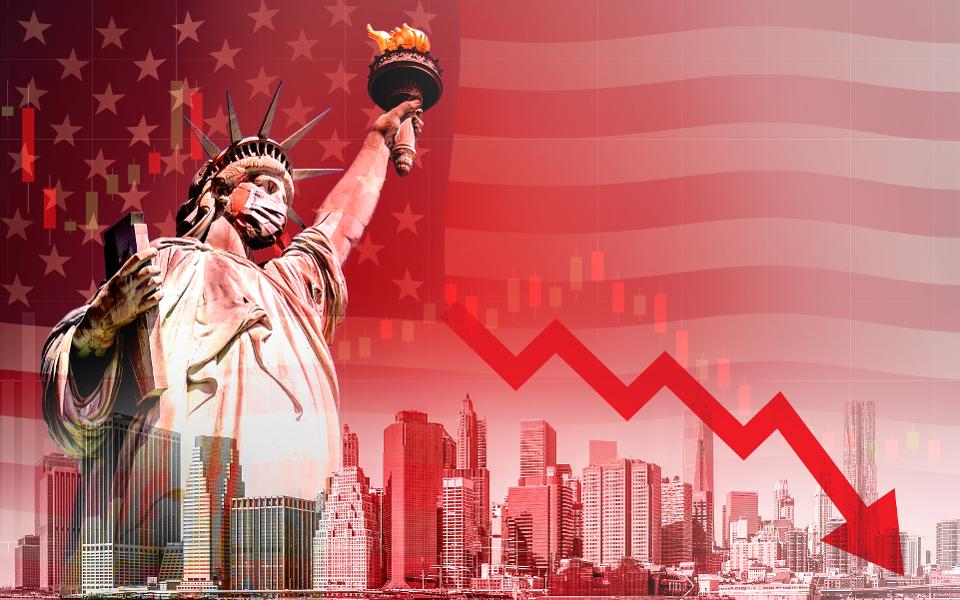
We will be emerging into a new world after the COVID19 pandemic subsides. It is now being called the “Economic Holocaust”

When we take into consideration $144.6 trillion in US Unfunded Liabilities, $20.4 trillion in Social Security Liability, and $31.6 trillion in Medicare liability, the nation lingers on the precipice a total collapse.

For all the uncertainties the COVID-19 pandemic poses to the world, especially in the US, one thing seems evident.  Our neoliberal capitalist civilization has proven itself to be unprepared for unexpected crises and catastrophes. For decades, the US has been falling behind other developed nations to infuse economic resiliency in society. Not only has the American medical system and federal health agencies been shown to be naked, we are also discovering we cannot rely on epistemological statistics and computer modeling alone to account for our flawed health policies.

Aside from the pandemic’s toll on people’s lives, there is also its impact upon the national economies and the global economy at large that is barely being discussed in any depth. Rather, hopes and wishes are being directed towards life returning to normal. We are expected to believe that our addiction to unconscionable consumerism will return, employment will rise and the American dream can again be mentally photo-shopped on the horizon. In short, we are persuaded that the comfort of our illusions and denial of harsh realities will return.  However, if a past Nobel laureate of economics, Joseph Stiglitz, is correct, then “if you leave it to Donald Trump and Mitch McConnell we will have a Great Depression.” Likewise, former Federal Reserve chair Jenet Yellen has also warned that the 30% GDP decline is leading us towards Depression. In fact, we may already be there.

As of today, the federal government has guaranteed $5.2 trillion dollars to keep the economy afloat as a depression worse than 1932 looms overhead. Some economists believe that this massive bailout is insufficient and upwards to $10-15 trillion may be necessary.  In 2008, with one broad stroke the Obama administration rescued Wall Street.  What was believed to be just the TARP bailout of $700 billion was in fact over $4 trillion worth of outlays, including TARP and other FED and Treasury expenditures.  The Levy Institute at Bard College calculated the outlays may have been as high as $29 trillion, a number the Sanders’ campaign had quoted.

Obama’s bailout was to assist the incompetency and corruption of Wall Street and the financial industry. Today it is a submicroscopic organism, approximately 120 nanometers (one nanometer is one billionth of a meter or about 20 oxygen atoms lined up), that threatens the financial well being of most Americans.

However before the COVID-19 reached our shores, the US was already in a horrible debt crisis.

Fiscal conservatives are angered that the US National Debt has reached $24.5 trillion while at the same time adamantly ignoring that the US Total Debt now hovers above $77 trillion. Neither party shows concern about Americans’ increasing personal debt (mortgage, credit card, auto, student loans, etc), nor the rise in corporate, state and city debts.

When we take into consideration $144.6 trillion in US Unfunded Liabilities, $20.4 trillion in Social Security Liability, and $31.6 trillion in Medicare liability, the nation lingers on the precipice a total collapse.

Before the pandemic, Trump boasted an unemployment level as low as 3.6 percent. But in the US, there are different ways to calculate unemployment figures. There is the official figure (U-3) that Wall Street and presidential administrations rely upon and then a more realistic statistic or U-6 that includes those underemployed and those only marginally attached to the work force.

Before the pandemic the “real” or U-6 employment was 6.9 percent.  Finally there is the shadow statistic, which adds the millions of Americans who have dropped out of the work force because their benefits ceased or because they are homeless or unaccounted for by the Labor Bureau.  When those adjustments are made, the shadow unemployment is likely around 23 percent.

Now, unemployment is skyrocketing.  The most recent estimate is that over 26 million people lost work during the past month and, according to Fortune magazine, the official unemployment rate may be as high 18 percent. 

Consequently a more accurate unemployment figure would be approximately 32 percent or almost a third of population. This is far worse than at the height of the Great Depression when unemployment stood at 25 percent.

The dark side of American jobs has been decades of large layoffs, workers being replaced by automation, downsizing, corporate consolidation due to equity partnerships, mergers and off shoring of manufacturing. In addition, tens of thousands of foreign professionals have received work visas and are eager to take the place of middle seniority positions in firms for lower salaries and without full benefits.  The system is so corrupt that the millions of people who work full time for less than a living wage are completely ignored. Hence most Americans are deep in debt and frequently live paycheck to paycheck. The fact of the matter is that there is no security whatsoever for millions of people who may not find work for a very long time.

Even if the lockdown were to end tomorrow, the lights would not immediately switch back on.

Throughout the financial news, we are reading headlines of companies eyeing bankruptcy as credit ratings are being rapidly downgraded.  Retail stores are being especially hit badly. According to Global Data Retail, over 190,000 retail stores have closed, accounting for nearly 50 percent of the nation’s retail square footage. Forbes has listed Dillards, JC Penny, Kohl’s, Levi Strauss, Macy’s, Nordstrom, and Signet to likely go under.  Others include Pier 1 Imports, Rite Aid, J Crew that is loaded up with private equity debt, Fairway supermarkets, and niche organic grocer Lucky’s. Macy’s capital alone dropped from $6 billion to $1.5 billion since February. This trend had already been rising since Trump came to office with large chain companies increasingly closing outlets including Walgreens, Gap, GNC, H&M and Victoria’s Secret. For sure, when and if the pandemic ends, there will be far less retail stores. The New York Times predicts very few are likely to survive. And we are not even looking at the hundreds of their vendors that are also being affected.

With 60 percent of Americans eating regularly outside the home, the restaurant industry is also being hit fiercely. Restaurants employ more minority managers than any other industry — approximately 60% — and employs almost 16 million people. Between 2010 and 2018, it represented the largest number of low middle class jobs ($45,000 to $75,000), 300 percent more than the overall economy. Now a restaurant apocalypse is underway, with an estimated 20 percent of restaurant operations going under. Larger chains are far better equipped. They are simply closing down dining room facilities and only offering carryout, pickup, delivery or drive-thru. Smaller independent restaurants are at the greatest risk.

Then there are the farms, the concentrated agriculture feeding organizations (CAFOs) and food chain suppliers. In the past it was very rare to enter a large grocery store and find empty shelves. Now it is a common sight because the food supply chain has been upended.

Pork and other meat suppliers such as Smithfield Foods, Tyson and Cargill are forced to close plants. Due to Trump’s draconian position on immigration of foreign workers, farm produce will not be harvested.

Niv Ellis at The Hill reports that “some $5 billion of fresh fruit and vegetables have already gone to waste.”  The pandemic, therefore, is contributing to rising food insecurity throughout the nation. Before the pandemic, Ellis notes, 37 million Americans were already food insecure.  The additional 26 million unemployed will increase that number, and it is sure to continue to climb. Finally, the UN Food and Agriculture Organization expects that the frantic efforts underway by countries to import basic staple foods may launch global food inflation.

We are also facing “the quickest and deepest oil demand crash in history,” says Richard Heinberg from the Post Carbon Institute. Oil prices plunged to an inconceivable negative minus $37 a barrel last week as global fossil fuel demand dropped roughly 30 percent. “The entire petroleum industry,” writes Heinberg, “is teetering.”  Natural gas producers relying on hydrofracking shale, which had already been burdened with high debt from private equity, are scrambling for bankruptcy protectionAccording to Reuters, “numerous midstream companies [in the energy sector] backed by private equity are in danger of bankruptcy.” With the collapse of hydrofracking companies, the pipeline firms have also entered troubled waters. The Federal Reserve Bank of Kansas City predicts that 40 percent of energy producers may be insolvent “if oil prices remain around $30 a barrel” for the year. Then consider the larger picture of the impact this has on the 6.4 million people working in the energy sector.

Also we might consider the future of 15 million Americans who work in the tourism industry, including hotels, entertainment, parks, museums, etc. It is estimated that 96 percent of global tourism has vanished in the blink of an eye.

State and local city governments are also “staring at budget shortfalls that will substantially exceed what they faced during the great recession.” States are reporting significant gaps in their capacity to remain fiscally afloat. The Republican Senate led by Mitch McConnell seems determined to withhold $150 billion of emergency funds to the states in the CARES Act before Congress — less than half of the $300 billion to $1 trillion state legislators are demanding. Consequently, states are staring into a deep abyss.

Americans who will either return to a job or seek work when the pandemic slows will be further imprisoned by an economy buried in greater debt.

  • Downsizing will accelerate along with borrowed money to continue operations while the White House refuses to pass a rent holiday, forgive student loans and other debts, cease payday loans, reduce interest rates on credit nor provide free healthcare for those infected with COVID-19;
  • The average person without a steady paycheck is living off savings and credit cards. Therefore, when the economy reopens, large numbers of people will be unable to return to the marketplace to circulate dollars;
  • As corporate debt mounts, the most insidious truth are the vultures of capitalism who will profit. These are the great white sharks in the finance industry that smell blood. For the trillions of dollars Trump is dishing out to the 1 percent, these are the first to get the lion’s share of the quarry.

Nobody in the mainstream media has properly criticized the huge monetary allocations being made for the pandemic. The FED is buying corporate debt in order for companies to off load their mistakes and receive fresh, new money. But the average small business receives the left over pennies.  The virus is teaching us the harsh reality about Washington pervasive culture of corruption. On this account both parties have no empathic regard for average citizens and small business owners.  Even the money from Trump’s and Mnuchin’s stimulus package given to citizens can be confiscated by debt collectors.

Imagine if you are an average citizen, not an insider, at the conference table with executives from Facebook, Google, the major banks and mega-corporate industries. You have no income or savings and no health insurance. If you are hungry, where do you get money for food? Where do you get money if you are sick or gas for your car? The unintended consequences of Trump’s and the Congress’ irresponsible and inhumane policies are literally bankrupting the nation.

By extension the millennial and iGen generations are the victimized recipients of this debt bequeathed to them by older generations. They are further compromised with the inability to secure jobs equal to their educational level nor secure a satisfying living wage. They are burdened with high interest student loans. They also are far more aware of the impact climate change will have on their futurs. Therefore, millions of young adults are rapidly losing faith in America’s neoliberal capitalist system and our self-centered culture of predation.

Similar to waking up the day following September 11, 2001, we will be emerging into a new world after the COVID19 pandemic subsides. It is now being called the “shut-in economy.” The pandemic is not solely a health crisis; it is equally an existential crisis, an impasse in the global civilization that is forcing us to realize that our over dependence and perverse reliance upon natural resources, such as fuel, energy, food and corrupt banking and healthcare services, is fragile. We are learning that at every level there are numerous cracks in our structures of governance and our economic and social bases.  Yet the virus did not break the nation; it has been broken for a long time. Only now more people are waking up from their dream. Furthermore, few people, including the mainstream media, now believe there will ever be a return to the normalcy of life that ended after Wuhan had its first patient infected with the virus. It is time for every individual to reassess her or his priorities. A life full of well-being is more possible today if we realize the virus has also been our teacher. But it is living a life that is founded upon simplicity, insight and wisdom, and community rather than consumption and competitive power.

Why American and Britain are Self-Destructing: How The Death Spiral of a Rich Society Begins With Austerity, and Ends With Poverty, Despair, and Collapse

There’s a simple fact that’s not noticed or remarked on nearly enough. The world’s two large English speaking societies, America and Britain, are collapsing. And they are collapsing in eerily similar ways, for eerily similar reasons, too. Yet in these societies, this basic point doesn’t seem to be understood much, if at all. And yet it’s not really a matter for debate. It’s a simple empirical fact.

There are only two societies in the rich world where life is getting shorter, poorer, meaner, and more hopeless — fast. Where life expectancies, incomes, and savings are all falling. America and Britain. Where middle classes have imploded, people live hand to mouth, and upward mobility has all but vanished. Where the idea of living a better life is somewhere between a joke and a distant memory. Where entire generations of young people — at last count, three, Gen X, Millennials, and Get Z — live worse lives than their parents and grandparents. Just two such societies where trust, happiness, and purpose have all imploded catastrophically — while depression, rage, anxiety, and suicide are all surging.

In fact, there are just a handful of societies with those grim statistics anywhere in the world — Venezeula, perhaps, Russia, North Korea, war torn African shells. Failed states, in other words. That is what America and Britain are becoming.

In a failed state, progress has become regress. That’s what happened to these societies. They are self-destructing. America, of course, is further down that road. But Britain is catching up fast. So how did they get here?

America and Britain have entered a vicious cycle, a death spiral. It’s a novel and bizarre phenomenon for a modern, rich society, unseen since Weimar Germany. It goes like this. In the 1980s, America began decades of underinvestment in public goods and social systems. It privatized whatever there was to privatize. The idea was that whatever it was — healthcare, education, finance — the private sector could do it better. The Reagan Revolution was in full effect — as a backlash to the advances civil rights made in the 1960s and 1970s, the good white American using “choice” as a shield to protect themselves from ever having to invest in or mingle with those dirty, filthy subhumans. All that was called “neoliberalism.” Let markets sort it all out! Translation: let the strong survive, and the weak perish.

But the result of massive underinvestment in public goods was predictable: stagnation, debt, falling living standards, and a permanent loss of mobility. More and more people were forced to desperately compete for all those “private sector” jobs, which didn’t really exist to begin with, since jobs were just slashed and cut en masse. Instead of creating tons of new jobs, the private sector built…huge monopolies, which, by today, employ scant numbers of people, like a Facebook or a Google or an Uber.

That competition for what few decent jobs there were led to massive wage stagnation. What “private sector” jobs did exist weren’t very good ones, and over time, they degenerated further, to the point that now many of them aren’t really “jobs” at all, but shells, with no benefits or mobility or protection. Today, America and Britain have record low unemployment…and plummeting real incomes. That should be an economic impossibility. It’s a reality that tells us their economies are unable to employ their populations at decent levels of income anymore.

At the same time, the “private sector” which was supposed to provide good healthcare, education, retirement, finance, and so on, began to charge the average American more and more for these things, while lowering their quality. After all, corporations are profit-seeking entities: their motivation is money. And so over time, the average American began to pay prices for things that astonished the rest of the world: $50K for childbirth, $200K for an education, and so on. How could they afford the basics of life at ever increasing prices — when their incomes had begun to stagnate? They couldn’t — so they began to go into massive debt (and today, the average American dies in debt.)

As a necessary consequence, social systems and public goods were eviscerated — and left undeveloped. America has no functioning social systems at all at this point, from healthcare to education to retirement — precisely because for nearly half a century now, it hasn’t invested enough (read: almost anything) in them. Hence, those poor kids in the pic above: they really don’t have much of a future, and increasingly, they know it.

Today, the situation is this. The average American is in a “low-wage job” — translation: they earn less than the poverty line. Yes, really. That’s why most Americans live paycheck to paycheck and can’t afford to save, much less ever live better lives than their parents or grandparents. He desperately needs things like healthcare, education, retirement, finance, to have any hope — any — of living a better life, instead of just a worse and worse one every year. But he himself can’t afford to fund those things anymore, because now his income is too low. How can he pay more in taxes to fund the things he needs most, like healthcare or retirement — when he earns a relative pittance to begin with? What is he supposed to live on then?

That, my friends, is a death spiral for an economy (and a society.) Let me put that more precisely.

America and Britain are in an austerity-poverty death spiral. Austerity causes poverty which causes more austerity which causes more poverty. It goes like this.

  1. Underinvesting in public goods and social systems led to fresh poverty
  2. As profit-seeking corporations lowered wages and raise prices.
  3. The result was that the tax base itself shrank — and now the average American or Brit will tell you they’re “too poor” to afford a functioning society. They’re not kidding. They are. They don’t have the money to invest in public goods or social systems anymore. They can’t make ends meet as it is.
  4. But without those very things, all that’s left is permanently, perpetually lower wages and higher prices…into oblivion, because that’s what a profit-seeking system demands.
  5. Bang! Game over. Your economy dies, and your society goes with it, pursuing follies like Brexits and Trumpisms, instead of solving its real problems.

Do you see the death spiral? Let me flip it on it’s head so it’s even more crystal clear. What’s the lesson here for other societies?

The less that we invest in public goods and social services as nations, the more that our economies corrode and our societies disintegrate. Incomes fall and prices rise, as all that’s left are people competing for private sector jobs, of which there aren’t enough, while paying ever increasing private sector prices. The average person is left impoverished. But because the average person is impoverished, there isn’t enough then left to fund the kind of tax base that can provide generous basics for everyone. Yet without those things, societies just decline into…forever. Regress becomes a way of life.

Below a certain threshold of investment, economies enter a death spiral. We must never let the amount that we invest in public goods and social services as a society fall too low. How low? Well, Britain and America give us hard proof: about 25% of an economy. When investment falls to that level, societies find themselves in the austerity-austerity-poverty death spiral. They may never emerge. Regress becomes locked-in, like in Russia.

(On the contrary, in Europe, rates haven’t fallen that low. They’re falling nonetheless though, hence reactionary movements like the Gilets Jaunes. And if they fall to such a point, Europe too will enter just such a death spiral.)

America and Britain’s future is questionable at this point — and I’m being generous. Think about what the above really means: these societies are caught in a trap from which there might well be no escaping. The average person needs more and better healthcare, education, finance, safety nets to ever live a better life again. But now they themselves are too poor to fund those things. What’s the obvious implication? That they will never have them again. That is the point. America and Britain let themselves be ruined. They fell into a trap — from which there is no good way out. Maybe no way out at all. Regress has likely become permanent, perpetual trend.

We are seeing a weird and gruesome new thing in the modern world. Rich countries which become failed states. In a precise and hard sense: they enter death spirals of austerity-poverty which cause a chain reaction self-destruction. That is the story of America and Britain’s twin collapses. Having let their investment rates fall too low, kicking off a vicious spiral of austerity and poverty leading to more austerity and poverty…which left the average person too poor to invest in anyone else, let alone him or herself…now no recovery towards a path of progress may be possible. Their future is just more of this, more regress, only harder and faster. Their destiny now well may be written in stone. They are joining nations like Russia and Venezuela in decline and collapse.

Let us hope that other nations are wise enough to learn from their mistakes. Because what follows folly is horror. What follows such death spirals, of course, is fascism, authoritarianism, and all the horrors of history.

Bill Gates Says We Should Prepare For The Next Pandemic: “That Will Get Attention This Time”

What Happened: Bill and Melinda Gates recently conducted an interview with the U.S. Chamber of Commerce. In the interview, Bill stated, with a smile, that humanity should prepare for the next pandemic “that will get attention this time.” Some media outlets are reporting that he was referring to the upcoming potential second wave, but if you watch the full interview that doesn’t seem to be the case.

He makes his remarks at approximately the 6-minute and 45-second mark of the interview.

Of course, Gates has received praise from virtually all mainstream media outlets for apparently “predicting” this pandemic in a famous TED talk.  In that TED talk, he also made the following statement:

Eventually what we’ll have to have is certificates of who’s a recovered person, who’s a vaccinated person […] Because you don’t want people moving around the world where you’ll have some countries that won’t have it under control, sadly. You don’t want to completely block off the ability for people to go there and come back and move around. So eventually there will be this digital immunity proof that will help facilitate the global reopening up.” (source)

Prior to this, Gates was quoted saying that things “won’t go back to completely normal until a vaccine comes out.” This resulted in tens of thousands, if not hundreds of thousands of negative comments on Gates’ Instagram.

Why This Is Important: Bill Gates and his influence within major organizations, like the WHO, is concerning. He is their biggest funder, and if what we’ve already seen with regards to the Wikileaks documents that show great influence over WHO policy from big pharmaceutical companies, what type of ‘pull’ does Gates have? He seems to be getting so much airtime on all major mainstream media as an expert.

What has also raised some concern among many people seems to be the fact that social media platforms have been censoring the opinion, research, and interviews with many renowned scientists who have been questioning the official stance taken by the WHO. YouTube and Facebook have been doing this on quite a large scale.

Sure, there is a lot of fake news out there, but when you go as far as silencing doctors and scientists from sharing their findings, that seems quite authoritarian/totalitarian.

Corruption runs rampant in this world, and information suggesting that powerful people have their hand in creating/influencing a problem for the purposes of proposing a solution has even more people asking questions.

At the end of the day, our thoughts and perceptions about major global issues and events are heavily influenced by major media companies that are owned by a very small group of corporations and people. Media has also been heavily used and created for psychological warfare purposes, which include mass propaganda campaigns. This is evident from Operation Mockingbird, which seems to be larger than ever today. It’s also evident that there is a heavy intelligence agency and corporate presence/influence.

It would be wise to listen to people like Edward Snowden and ask ourselves if governments and powerful people are simply using the coronavirus to introduce even more authoritarian measures upon the population, like he, and many others have.

For example, more surveillance, the continual move towards a completely digital world, where nearly all aspects of our lives are digitized for tracking purposes, is happening. Contact tracing apps and new software being downloaded automatically to phones already suggests this with QR codes.

A QR code works in the same way as a barcode at the supermarket. When your smartphone scans the code of black squares and dots, it translates that information into a link that leads to something recognizable — like a PDF of a restaurant menu. In this case, it may be your vaccination status, or if you’ve been in contact with anyone who has Covid, or what it’s being advertised for by Forbes, a method to eliminate cash and credit cards and go completely digital with that.

When it comes to health information within QR codes being scanned, earlier I mentioned Bill Gates comments about a digital ID. Is there something to put together here?

The Takeaway

At the end of the day, more people, including scientists from within government health agencies, are pointing to “rogue interests” when it comes to science and decision making. This topic alone when it comes to Bill Gates is quite large, requires a lot of research, and really brings up some questionable behaviour.

This short video may be of interest to you: Who Is Bill Gates?

Do we really want to continue taking advice and instruction from people who don’t seem to actually have our best interests in mind? Should we continue to rely on them for information, or should we start looking into things more for ourselves?

Many people are experiencing a change in perception with regards to what is and what has been happening on our planet for a long time.

Human beings have unlimited potential, and we can change the game at any time

Americans struggled to process what is real, trustworthy and authentic as the unraveling of deep political decay revealed a behind-the-scenes subterranean power struggle that has surfaced with the intent on disintegration of American Society

If given the choice between maintaining a toxic world of fear, pollution and violence controlled by the State or a society of prosperity and compassion based on freedom and individual rights, there is little doubt that the majority of Americans would want the old paradigm of synthetic events to take a hike; except that choice has been distorted under the guise of what the World Health Organization (WHO) has mislabeled the most deadly virus in history.

The coronavirus crisis arrived in a flash with little time to analyze exactly WTF was going on. Americans struggled to process what is real, trustworthy and authentic as the unraveling of deep political decay revealed a behind-the-scenes subterranean power struggle that has surfaced with the intent on disintegration of American Society.

While the country is fast approaching an existential crisis on steroids, millions experienced an inner knowing that some indefinable thing was not right with recognition that the early explanations were hogwash while others, addicted to mainstream/social media who still believed in the illusion of democracy, were on board with the litany of spin from the medical and political establishment.

While the Lockdown could have been a wake up call for humanity to change its consciousness with a paradigm shift – whether it be a spiritual awakening, a political realignment or re-evaluating one’s own personal health choices, since, after all, humanity was locked in a major health crisis. And most importantly, it was an opportunity to acknowledge that the planet itself is ailing from abuse and neglect with CV as a metaphor urging a personal reconnection with Nature.

In early 2020, Neil Ferguson of the UK’s Imperial College used a scare tactic to predict that 80% of Americans would be infected and that there would be 2.2 million American deaths – neither of which materialized. Yet Ferguson’s extremism accomplished its intended purpose in establishing the basis for draconian Lockdown requirements. Ferguson later retracted his earlier prediction down to 20,000 fatalities.

With current infection fatality rate at 0.20%, Lockdowns have been devoid of science and are based on arbitrary, contradictory and inconsistent requirements.
Nancy
Just a few examples come to mind, such as liquor stores and big chains are considered ‘essential’ and remain open but stand-alone, independent, mom ‘n pops are not. Barbers may be open but hair salons may not. While it is advised to get tested for Covid19, a colonoscopy or other elective surgery are not allowed. While vitamins C and D and Sunshine strengthen the immune system, all outdoor sport programs have been canceled.

In an unexpected development, a recent JP Morgan study asserted that the Lockdowns failed to “alter the course of the pandemic” as it “destroyed millions of livelihoods” and that as infection rates ‘unrelated to often inconsistent lockdown’ measures decreased, fewer outbreaks were reported as the quarantines were lifted.

As the official narrative of the Covid19 as an existential threat has collapsed, it is interesting to follow how ‘hot spots’ occur just as a particular State, like Florida, announces re-opening.

Those new hot spots encourage a reinvigorated debate over mandatory face masks and social distancing with its success depending on a duplicitous media instilling panic and a naive public still believing Covid19 to be more dangerous than seasonal flu.

WHY LOCKDOWN ASYMPTOMATIC CITIZENS?

Dr. Maria Van Kerkhove, technical lead of WHO’s COVID19 Task Force threw a monkey wrench in the works recently by stating:

what we really want to focus on.. if we followed all the symptomatic cases, isolate those cases, follow those contacts and quarantine those contacts, we would drastically reduce..transmission. We would do very, very well…”

Dr. Van Kerkhove then explained that transmission of the virus from asymptomatic patients appears to be very rare:

It still seems to be rare that an asymptomatic person actually transmits onward to a secondary individual.”

The next day, there was panic at the WHO but Dr. Van Kerkhove’s uncensored comments were very clear as they validated questioning the purpose of the entire Lockdown process. If an asymptomatic person is not spreading the disease but might publicly increase herd immunity, then why wear a face mask or be quarantined?

House Speaker Pelosi called for a national mask mandate as HHS Secretary Azar reported that Pence and Trump are tested daily and are asymptomatic; therefore not required to wear a mask.

WHY FACE MASKS?

To date, there is no standard for what constitutes a ‘safe’ face mask or instructions for disposal considering that a used face mask will be a contaminated bio-hazard material; ergo a face mask is more of a device to require citizen compliance than a safety precaution.

Adding a partisan narrative to the crisis, the most expansive lockdown restrictions (some with criminal penalties) came from predominantly Democratic Governors and Mayors who offered no science or forensic data to prove that either mandatory face masks or home sequestration have failed to prevent a spread of the virus.

During a House Oversight committee meeting, the mask debate broke down along party lines with Dems dutifully covered while strenuously objecting to their mask-free peers.

A riveting June 23rd Palm Beach County Commission public hearing on a proposed Mandatory Face Mask ordinance drew overwhelming opposition.

While OSHA’s (Occupational Safety and Health Agency) responsibility is to oversee the health and safety of every American worker as each workplace is expected to comply with OSHA standards, its website regarding COVID19 states that cloth-based face masks

will not protect the wearer against airborne transmissible infectious agents due to loose fit and lack of seal or inadequate filtration.“

OSHA goes on to inform that a safe level of oxygen must be maintained as an oxygen deficient atmosphere (defined as below 19.5% by volume) creates a respiratory risk.

While there is no sound science or evidence to prove the benefits of mandatory usage, the NE Journal of Medicine reported that:

We know that wearing a mask outside health care facilities offers little, if any, protection from infection […] The chance of catching Covid-19 from a passing interaction in a public space is therefore minimal. In many cases, the desire for widespread masking is a reflexive reaction to anxiety over the pandemic.”

More recently, NIAID Director Dr. Anthony Fauci declared masks as largely ‘symbolic’ as he was setting an example for what other people should be doing.

There’s also a “Risk of Hypoxia to All Mask Wearers” according to Drs. Russell Blaylock and Zach Bush.

SOCIAL DISTANCING AKA QUARANTINE

With not a whit of science in support, Social Distancing which is a mutually exclusive phrase since there is nothing social about enforced distancing from other humans, has been attributed to a CIA protocol in use since the 1950’s to break a prisoner’s resistance or a teenage science project.

In any case, SD has proven a great way to erode an individual’s normal need for social contact, to effectively starve the brain function of human interaction and comparable to other emotionally unhealthy deprivations. As former Vietnam POW John McCain related “It crushes your spirit more effectively than any other form of mistreatment.”

Rules 3 and 44 of the Nelson Mandela Rules warn of being cut off from the outside world and prohibits more than two weeks of isolation as cruel and inhumane treatment.

*

While the manufactured COVID 19 health crisis opened the door for the World Economic Forum and its friends to activate One World Government, millions of Americans continue to play the cognitive dissonance game with little awareness they are witnessing a government takeover with increased surveillance and censorship. As coordinated violent protests in Seattle and DC spread a thinly veiled political coup, all accomplished more easily while the American public were in Lockdown.

The US is currently experiencing what might be called a ‘triple crisis’. A health crisis that shows little sign of abating. A deep economic crisis that is still in its early phases. And a ripening political crisis

The reopening of the US economy in June—and some states as early as May—has produced a modest economic ‘rebound’. But rebound is not to be confused with economic recovery.

The current rebound is the natural result of the US economy collapsing 40% between March and June 2020. In the first quarter, January-March 2020, the US economy contracted 5%, virtually all of that in March. While the final data for the 2nd quarter is yet to be announced, the US Federal Reserve Bank’s forecasts of US Gross Domestic Product (GDP) show a much greater collapse, ranging from -30.5% (NY Fed district) to -41.7% (Atlanta Fed district).  No economy can continue to collapse at that steep a rate quarter after quarter.

Economies experiencing deep and rapid contractions—which is typical of both great recessions and economic depressions—inevitably experience periods of leveling off for a time, or even a slight bounce back—i.e. a rebound. But that’s not a recovery. ‘Recovery’ means a sustained, quarter to subsequent quarter economic growth that a continues more or less unabated until the lost economic ground is ‘recovered’. But a rebound is typically temporary, followed by subsequent economic relapses in the form of stagnant growth or even second or third dip recessions.

Look at the Great Recession 1.0 that began in December 2007. The decline began that month subsequently declined more rapidly in the first quarter 2008, but then bounced back slightly in the 2nd quarter 2008. It then took a deep dive in the second half of 2008 through the first half of 2009, contracting every quarter for an entire year. A short, shallow recovery followed into 2010. But the economy relapsed again in 2011, contracting once more for two quarters in 2011. Another small rebound followed in early 2012 and was followed by stagnation in the second half of 2012.

The reported GDP numbers after 2008 were even weaker, and the relapses more pronounced, before the US Commerce Dept. changed the way it defined US GDP and boosted the totals by $500 billion a year after 2013, retroactive to 2008 and before.

All Great Recessions with an initial deep economic contraction, are typically followed by brief shallow recoveries, cut short by subsequent double dips or quarters of no growth stagnation.

That was true of the Great Recession of 2008-09, which didn’t really end in June 2009, but bounced along the bottom economically for several more years. A similar trajectory will almost certainly follow today’s 2020 Great Recession 2.0 now concluding its Phase One initial deep collapse.

The Phase One deep collapse is now giving way to its Phase Two and what will prove a brief and quite modest ‘rebound’. But that’s not a recovery.

Further economic relapses are inevitable after ‘short, shallow rebounds’ that characterize all Great Recessions. That trajectory—i.e. short, shallow rebounds followed by relapses also brief and moderate can go on for years.

What it means is there will be no V-shape and true recovery in the US economy in the second half of 2020. What there will be is an extended ‘W-shape’ period, the next two years 2020-2022 at minimum. And it may continue for perhaps even longer.

The 1929-30 Great Recession: Anteroom to 1930s Depression

A similar scenario occurs prior to bona fide economic depressions, like that which occurred in the 1930s.  The great depression began initially as a Great Recession. US policy makers failed to contain it and it slipped into the Great Depression of that decade as we know it. What precipitates Great Recessions collapsing into bona fide Depressions is the collapse of the financial and banking system.

The Great Depression of the 1930s did not begin with the stock market crash of October 1929, however. The real economy was already slipping into recession in manufacturing and construction sectors in 1929, well before the October 1929 stock market financial crash.  The economy contracted in 1930 by -8.5% and continued to contract every year thereafter through mid-1933 as the US economy experienced a series of four banking crashes, one each year from 1930 through 1933. The banking crashes drove the real, non-financial economy ever deeper every year, in a ratchet like effect.

Rebound and growth followed 1934-36. However, that weakened significantly in late 1937 as a conservative Republican Congress and Supreme Court together began dismantling Roosevelt’s 1935-37 New Deal social spending fiscal stimulus programs. As a result, in 1938 the US economy fell back into depression once again. A partial reversing of the dismantling in 1939 produced a return to positive GDP growth that year. But it wasn’t really until 1941-42 that the economy really exited the Great Depression, as US GDP rose 17.7% in 1941 and then 18.9% in 1942. Recovery—not rebound—was clearly underway after m id-1940—i.e. the result of government spending on both social programs and defense that amounted to more than 40% of GDP those years. That was fiscal stimulus. That was recovery.

In other words, the lesson of the Great Depression of the 1930s is in order to end a depression, or stop a Great Recession from becoming a Depression, the government must step in and spend at a rate of 40% GDP.

Prior to the onset of the current 2020 Great Recession 2.0, the US government’s spending and share of US GDP was about 20%.  It needs to double to 40% to engineer a true recovery from the current crisis.  5.5% is no stimulus in fact; just a partial ‘mitigation’ of the severe collapse that just occurred. That is, a temporary floor under the deep 30%-40% collapse that would have been even greater.

The 2008-09 Great Recession: The 5.5% Failed Stimulus

In January 2009 the incoming Obama administration proposed a fiscal stimulus recovery package amounting to roughly $787 billion and 5.5% of GDP. Economists advocated double that. Even Democrat party leaders in the US House proposed another $120 billion in consumer tax cuts. But Obama’s economic advisers, mostly former bankers and pro-banker academics like Larry Summers, argued the US could not spend that much. Obama listened to Summers and reduced the amount to the $787 billion.  It proved grossly insufficient. The real economy continued to lag and job losses continued to mount. Supplemental programs like ‘cash for clunkers’ and ‘first time homebuyers’ had to be added.

Even with these post-January program supplemental spending Obama’s fiscal stimulus proved insufficient to generate a robust recovery, as the historical record shows. The US recession under Obama ‘recovered’ at its weakest rate compared to all the prior ten US post-recession recoveries since 1947. The Obama recovery was only 60% of normal for recession recoveries.

The problem with the Obama 5.5% was not only the insufficient magnitude of the stimulus. Its composition was deficient as well. It called for almost $300 billion of the $787 billion in mostly business tax cuts, which were then hoarded by business and not invested to expand output, hire more workers, and generate thereby more income for consumption.  Nearly $300 more was in the form of grants given to the states to spend. They too hoarded most of it and failed to rehire the unemployed as was intended. The remainder of the $787 billion was composed mostly of long term infrastructure investment and spending that had little initial effect on the economy’s recovery. As a result of the insufficient magnitude and poor composition of the Obama 2009 stimulus, the US economy fell into a ‘stop-go, W-shape economic recovery for the next six years. US jobs lost in 2008-09 were not recovered until as late as 2015, and the average wages paid for the new jobs was significantly less than wages paid for the jobs that were lost.

Another major contributing factor to the weak economic recovery under Obama was the agreement between Obama, US House Democrats and the Republican Senate in August 2011 to reduce spending on education and other programs by $1.5 trillion. Thus the $787B stimulus of 2009 was reversed by more than twice, as austerity was introduced in late 2011. More than twice what was injected into the economy in 2009 was taken out again starting in 2012. The inadequate less than $1trillion fiscal stimulus was over in just two years!

The point is: apart from the matter of austerity in 2011, if 5.5% was insufficient to generate sustained recovery in 2009, today in 2020 the 5.5% fiscal spending produced by the CARES ACT in March 2020 will prove even less successful.

The US economy’s economic collapse today is five times deeper than in 2008-09 and has occurred in one-fifth the time of the 2008-09 event. If a second more aggressive government spending program does not follow in the second half of 2020, then the current tepid economic ‘rebound’ underway due to the reopening of the US economy will certainly fail at generating a sustained recovery. Here’s why the CARES ACT—the main and only stimulus program to date—is only 5.5% and will fail to generate a sustained recovery as the economy reopens with a modest ‘rebound’.

The March 2020 CARES ACT: Failed Stimulus Déjà vu

As of mid-year 2020 the US government spending to date is summed up in the various provisions of the CARES ACT passed by Congress in March 2020, plus several smaller measures passed before and after it as supplements. Its actual spending as of late June 2020 amounts to only approximately a 5.5% contribution to US GDP.

The CARES ACT on paper called for $1.45 trillion in loans and grants to small, medium and large businesses. $500 billion is allocated as loans to large corporations. Another $600 billion to medium sized plus some other measures. And $350 billion in loans, convertible to grants, to small businesses called the Payroll Protection Program, or PPP.

Another $310 billion was added to the PPP small business loan program as banks quickly misdirected hundreds of billions of dollars to many of their ineligible bigger business prime customers which scooped up much of the original $350 billion for small business.

The three business programs combined thus allocated $1.76 trillion in loans and grants.

Another $500 billion was allocated to workers and US households in the form of supplemental income checks of $1200 per adult plus an extra $600 in federal unemployment benefits available through July 31, 2020.

A couple hundred billion dollars more went to hospitals and health care providers in emergency reimbursements before and after the March CARES ACT passage.

That brought the total March CARES ACT fiscal stimulus to roughly $2.3 trillion. However, not discussed much in the media is another $650 billion CARES ACT provided business and investor tax cuts. The tax cuts include a temporary suspension of business payments to the payroll tax; more generous net operating loss (NOL) corporate tax averaging that allows business to use current losses to get tax refunds on prior year taxes paid; faster depreciation write-offs ( de facto tax cut); and more generous business expense deductions.  Less than 3% of the $650 billion tax cuts in the CARES ACT went to families earning less than $100,000 per year in annual income.

On paper, the roughly $2.3 trillion CARES ACT amounted to roughly 11% of GDP. But only half of that 11%–or just 5.5—has actually hit the US economy. This contrasts with Germany and other European and Asian countries that boosted fiscal spending stimulus by as much as 15%-20%.

Another 5.5% Stimulus Means Another Failed Sustained Recovery

The 5.5% to not enough to kick start the rebound into a sustained recovery. Much of the 5.5% is already spent to mitigate the 2nd quarter deep contraction and is no longer available as a stimulus in the upcoming 3rd quarter.

All the $1200 checks have been spent already and most of the $600 unemployment benefit boost has entered the economy. The latter expires on July 31. Furthermore, the majority of the $1.7 trillion allocated to businesses large and small has yet to get into the US economy as well.

Of the $660 billion in the small business PPP program, about $520 billion has been spent. Less than $100 billion of the $500 allocated to large businesses, like airlines and defense companies, has actually been ‘borrowed’ by big business. And as mid-June 2020, none of the $600 billion for medium size businesses had yet been ‘taken up’ by those businesses. The program was only fully launched late June, more than three months after it was first announced in March.

Thus far little interest appears on the part of medium and large businesses in the more than $1 trillion loans allocated to them.  And as far as the $650 billion in tax cuts is concerned, its effects can be delayed until December 31, 2020, if even then. Given the weak US economy and consumer demand, many businesses will take the tax cuts and hoard them.

In short, more than half the roughly $3 trillion total of government spending, loans, grants and tax cuts provided by the CARES ACT is yet to be committed to the US economy. The official 11% is really only half that at best.

This fact leads to the interesting question: Why have medium and large businesses not take up more of the $1.1 trillion business loans allocated to them?

The $3+ Trillion Uncommitted Business Cash Hoard

The answer is they haven’t because they are already bloated with cash and don’t need or want it. That cash hoard has resulted from several sources in recent months: Large corporations saw the writing on the wall with regard to the virus as early as January-February 2020. They quickly began loading up on cash by drawing down their generous loan credit lines with their banks. That produced a couple hundred billion dollars in cash by March. Then they issued record levels of new corporate bonds to raise still more cash. From March to end of May more than $1.3 trillion in new corporate investment grade bonds was raised by the Fortune 500 US businesses—i.e. more than in all 2019. A couple hundred billion dollars more was raised in junk grade corporate bonds.

Still another cash source was raised by businesses suspending dividend payments and stock buybacks to shareholders. In 2019 they distributed $1.3 trillion in buybacks and dividend payouts

($3.4 trillion total under Trump’s first three years in office). So buybacks and dividends suspensions saved at least another $500 billion in cash.  Companies also began selling off and cashing in their minority stock interests in other companies.  Furloughing workers to work from home also saved still more cash in reduced facilities, benefits and related costs for many corporations. Tech companies especially benefited from this.

Bloated with trillions of dollars of cash, large and medium sized corporations had little interest in borrowing from the CARES ACT, since the latter came with conditions like the provision that 70% of the loans be spent on keeping workers on their payrolls.  They preferred to lay off their workers, and borrow from the credit markets, issue new bonds, and otherwise conserve cash.

A good example was Boeing Corporation. Congress allocated more than $50 billion to Boeing as part of the $500 billion loan program earmarked for large corporations. Instead of borrowing that, Boeing raised $25 billion issuing new bonds and announced layoffs of 16,000 of its workers! Less than $100 billion has been used to date by large corporations under the CARES ACT big corporations’ $500 billion loan allocation. And virtually nothing of the $600 billion to date allocated under the medium size business loan program called the ‘Main St.’ lending facility.

7 More Reasons Why ‘Rebound’ Won’t Mean Recovery

Here are some seven other reasons—apart from the US current insufficient fiscal stimulus—why the US economy will not experience a sustained ‘recovery’ in the next six months, and why instead the US will follow a W-Shape trajectory of weak un-sustained growth followed by economic relapses through 2020-21 (and perhaps even longer):

 1) 2nd Covid-19 Wave Economic Impact:

It is inevitable a number of states will reinstate shutdowns—in significant part if not totally—as the infection, hospitalization, and death rates rise over the summer due to premature reopening of the economy and a growing breakdown of social discipline in adhering to basic precautions like social distancing and mask wearing.  The partial shutdowns will. To varying degrees, reduce consumer spending, business investment, and result in re-layoffs of workers. Second wave layoffs in services like leisure & hospitality, bars, restaurants, travel, public entertainment, and even education and health care services will emerge—all negatively impacting household consumption demand.  It is estimated that at least half of the states, 40% of the reopened economy, will reinstate some degree of re-closures of business activity in coming weeks and months as a resurgence of Covid 19 impacts the US economy in the second half of 2020 and beyond.

The official US June employment report on July 3, 2020 showed 4.8 million jobs were reinstated. But no less than 3 million of that 4.8 million were recalls in leisure & hospitality, hotels, bars, restaurants, and retail industries. These are the same industries that will be affected most by states reinstituting shutdowns. They are also industries where businesses that have been able to reopen only partially thus far in most cases operate on very thin margins. They are likely to fail in Phase Two of the crisis now beginning, and many closing completely in the second half of 2020 as a result of operating only at half capacity.

The scope of the possible closures is revealed by the recent Yelp survey of 175,000 of its customer business base. During the 2ndquarter, Yelp’s survey found that in May-June only 30,000 of its 175,000 had reopened. More important, its survey showed that 40,000 of its 145,000 that hadn’t yet opened had already closed permanently. The wave of permanent business closures in the second half of 2020—especially in the leisure & hospitality and retail industries—should not be underestimated. The permanent shutdowns will occur not only due to reduced consumer demand, but to a resurgence of Covid-19 and a second wave of layoffs.

2) Deeply Entrenched Business & Consumer Negative Expectations

The US economy has been deeply wounded by the deep contraction of the past four months. Both businesses and consumers have negative expectations as to the direction of the economy in the short to intermediate run. Businesses don’t see the conditions for returning to expanding investment, or even returning to prior levels of production and output. With consumer demand clearly in retreat, business expectations of future sales and profits are dampened. Reducing the cost of investing by lowering business taxes or interest rates have little effect on generating more investment, when expectations of profitability—which is what really drives investment—are so low. This is the fundamental reason why business across the board is hoarding its accumulated cash.  The same applies to consumers and households. They too are hoarding what cash they have available, spending mostly on necessities only.  The evidence is the sharp rise in the household savings rate and bank deposit rates. As much cash is saved and deposited as a precaution that economic conditions may worsen, instead of actually spent. The result is only minimal increase in spending occurs, just as minimal investment.  Until negative expectations are somehow reversed, both business investment and household consumption do not rise to levels that result in sustained ‘recovery’.

It will take a major event to again shift business and consumer negative expectations, like a vaccine for the virus or a major fiscal stimulus or a program of mass hiring of the unemployed by government. However, none of the above is on the immediate horizon. Therefore negative expectations will continue to dampen any sustained recovery and limit whatever insufficient government fiscal stimulus to generating a modest ‘rebound’ at best.

3) Business Cost Cutting & Permanent Layoffs

The deep and rapid rate of contraction of the economy over the past four months, and the business expectation of weak recovery, has convinced many businesses to make many of the cost cutting moves of recent months permanent. An example is how some industries and businesses moved their workforces to work from home. It has saved them significant costs of operation—on facilities, maintenance, and some employee benefits. In recessions businesses always find new ways to cut costs that often result in more layoffs and lower wages. Another phenomenon is rehiring and recalling workers back to work temporarily laid off does not occur en masse and all at once. The typical business practice is to recall only part of their workforce and to recall workers more on a part time basis. Not least, the cost cutting and the part time recalls typically results in businesses leaving part of their furloughed work force behind, whose unemployment then becomes permanent.

This second wave of jobless is already beginning to emerge, as businesses downsize in employment after the initial shock to the economy that has already occurred. Airlines are announcing tens of thousands of layoffs. Several other industries are experiencing growing defaults on debt payments and bankruptcies that will result in mass layoffs as well. For example, the oil & energy sector which was a major source of new job creation during the fracking boom of the past five years. More than 200 defaults of companies are in progress. Layoffs are beginning, of a permanent nature not just temporary furloughs or layoffs.

Cost cutting and layoffs translate into less household income for consumption and therefore for generating a sustained recovery.

4) Deeper Global Recession & Global Trade Crisis

The collapse of the US economy in the first half of 2020 has been accompanied by a synchronized contraction of the global economy.  Global economic contraction means US production for export does not recover much in the short run. Offshore demand for US goods & services remains weak. That in turn dampens domestic US investment, employment, and therefore business-consumer spending. Although the US economy is relatively less dependent on exports to stimulate economic growth, exports are not an insignificant contributing factor to US growth and recovery.

More than 90% of the world economy has also experienced deep recession in the first half of 2020. That compares with the first Great Recession of 2008-09 when a fewer 60% of countries were in recession along with the US. Foreign demand for US exports is thus even weaker this time around. Post 2009 China and emerging market economies boomed after 2010 and put a partial floor under US economic contraction by stimulating demand for US product exports; that China-Emerging Market economies stimulus effect on the US economy no longer exists in 2020.

5) Intensifying US Political Instability

One should not underestimate the potential growing political instability in the USA in the second half of 2020.  This instability will occur on two ‘fronts’. One is at the level of political institutions. It is likely the upcoming national elections on November 3, 2020 will be challenged and not accepted by either Trump or the Democratic Party nominee. The growing social instability in the USA and Covid 19 effects on voter turnout, combined with the already widespread voter suppression in various states, makes for ripe conditions for post-electoral crisis should the election be narrowly decided by voters in November.  Evidence is growing, moreover, that Trump is prepared to declare voting by mail as fraud and use that as an excuse to throw the election into the Supreme Court—as occurred in the US in 2000.  Today Trump, unlike George W. Bush in 2000, enjoys an even firmer majority in the US Supreme Court.

The instability at the level of political institutions in the USA today is accompanied by what appears as growing grass roots civilian conflicts. Street level confrontations between Trump supporters and rising popular movements and demonstrations are not beyond the realm of possibility, perhaps even likelihood.

The political instability has significant potential to negatively impact both consumer and business expectations and therefore dampen both business investment and household consumption even further in addition to causes already noted.

6) Wild Card #1: Financial Crisis 2021

Intermediate term, in 2021 likely more than in 2020, is the wild card of a financial system crisis emerging that would exacerbate the real economy’s faltering recovery still further. This channel by which a financial crisis might emerge is a growing wave of corporate and state & local government defaults. Massive excess debt has built up over the past decade in business sectors in the US.  More than $10 trillion in corporate bond debt exists at present. At least $5 trillion in corporate junk bonds and virtual junk like BBB investment grade. Still more for corporate ‘junk’ leveraged loans. A protracted period of recession and weak recovery will generate a major potential for corporate defaults and bankruptcies. If the magnitude and rate of defaults is too great, or comes too fast, the banking system could very well experience a major credit crash once again.

Industries highly unstable with high cost unaffordable debt, and with insufficient revenues with which to service that debt, include: oil fracking and coal, big box retail, smaller regional airlines, rental car and other travel related companies, hotels and resorts, malls, commercial property in general, and hundreds of thousands of small restaurants and regional restaurant chains. Defaults have already begun rising rapidly in many.  Household debt and state and local government debt finds itself in much of a similar situation—highly leveraged with debt amidst collapsing incomes to service the debt as unemployment and wage incomes continue to decline and as tax revenues remain depressed long term due to the weak economic recovery.

The US central bank, the Federal Reserve, is in the midst of an historic experiment to pre-bail out non-bank corporations to forestall the defaults and to flood, at the same time, the US banking system with massive excess liquidity with which to manage the defaults should they come excessively and too rapidly.  It remains to be seen whether the Fed’s massive liquidity injections thus far ($3 trillion), and promised (unlimited), will prove sufficient to manage the defaults.  If not, the US banking system will freeze up as financial institutions begin to crash as well with the transfer of defaulted corporate debt on to their own bank balance sheets.

In 2008-09 it was the banking system that collapsed first and in turn precipitated a deeper and faster contraction of the real economy in the US. Today it is quite possible the reverse causation may occur in the Great Recession of 2020. But it matters not in a Great Recession which precipitates which first—i.e. the banking system the real economy or vice-versa. The key point is that both cycles—financial and real—feed back on the other in a Great Recession and amplify the downturn in both.

7) Wild Card #2: Artificial Intelligence Faster Rollout

Another wild card that may emerge with fuller force longer term is the penetration of Artificial Intelligence in business operations.  McKinsey Consultants estimated that by 2025 AI would accelerate in its penetration of business practices. By the latter half of the 2020s decade it would have deep and widespread impact on employment and wages, as AI led to deep cost cutting by business. As much as 30% of occupations would be seriously impacted. The essence of AI is to eliminate simple decision making jobs, in services as well as manufacturing.

But it is highly possible that AI will now penetrate even faster, accelerated by business cost cutting and productivity enhancing drives, as a consequence of the current deep economic crisis.  The deeper and more protracted the current recession, the more likely business will engage in multiple ways to reduce costs as a means to weather the crisis. AI offers businesses a prime opportunity to do just that. But AI also means a significant reduction in net jobs, especially simple low paid service and retail work. And with the net jobs and wage loss come reduced consumer household demand, consumption, and therefore sustainable economic recovery.

The Case for 40% Government Share of GDP

As previously noted, recoveries from great recessions and depressions require at least a 40% US government spending share of total GDP. Obama’s raised the US government share of GDP to barely 25%, not 40%. The economy accordingly struggled after 2009.

The current 2nd Great Recession 2020, the first phase of which has just concluded in June, is following the same rough trajectory and scenario as the 2008-09. There has been only token fiscal stimulus to the economy thus far from the CARES ACT. Indeed, Congress never considered, at least in the House of Representatives, the CARES ACT was a stimulus bill. It was called a ‘mitigation’ bill, designed to put a partial floor under the collapse of the economy going on at the time in the 2nd quarter 2020. A true stimulus bill was to follow. That’s the HEROES ACT now blocked in Congress by Republican Senate and Trump. What the latter want is to end the unemployment benefits and provide no further income supplement payments. They want to exchange further unemployment benefits for direct wage subsidies to businesses. They want even more tax cuts for business—permanent payroll tax cuts, more capital gains tax cuts, and more business expense deductions. And they are reluctant to provide funding support for state and local governments with accelerating deficits as a result of tax revenue collapse. Should support for state and local governments not occur soon, it is likely mass layoffs will emerge in states and local governments soon.

However, it does not appear so far that anything resembling a real stimulus will get passed with the HEROES Act. The unemployment benefits extension will likely be eliminated. More business tax cuts, should they be added to the $650 billion provided by the CARES ACT, will be hoarded in large part. As will corporate income that would have been otherwise used to pay wages, as the government pays the wages of their workers instead.

An insufficient fiscal stimulus from an eventual HEROES Act, should it occur, will ensure the current tepid ‘rebound’ of the US economy will fail to evolve into a sustained recovery of the US economy. The seven other, additional factors noted above will further prevent a sustained recovery—and indeed may precipitate a subsequent further serious economic contraction. The summer of 2020 is thus a critical juncture period for the US economy.

The US is currently experiencing what might be called a ‘triple crisis’. A health crisis that shows little sign of abating. A deep economic crisis that is still in its early phases. And a ripening political crisis. Never before in its history have three such major events converged. The one of the three that is potentially most manageable is the economic. Health crisis depends heavily on the development of a vaccine. Not much can be done to prevent a deepening political crisis. It will run its course, whatever that may be. But a government fiscal stimulus equivalent to about 40% of US GDP would very likely stabilize the economy and set it on a path to sustained recovery.  However, it is highly unlikely that in the current political climate of instability, deep splits within the US political elites, growing grass roots social confrontations, and failure to mount an effective strategy to address the Covid-19 health crisis that the capitalists and their political representatives will be capable of introducing the necessary 40% war time economic stimulus.
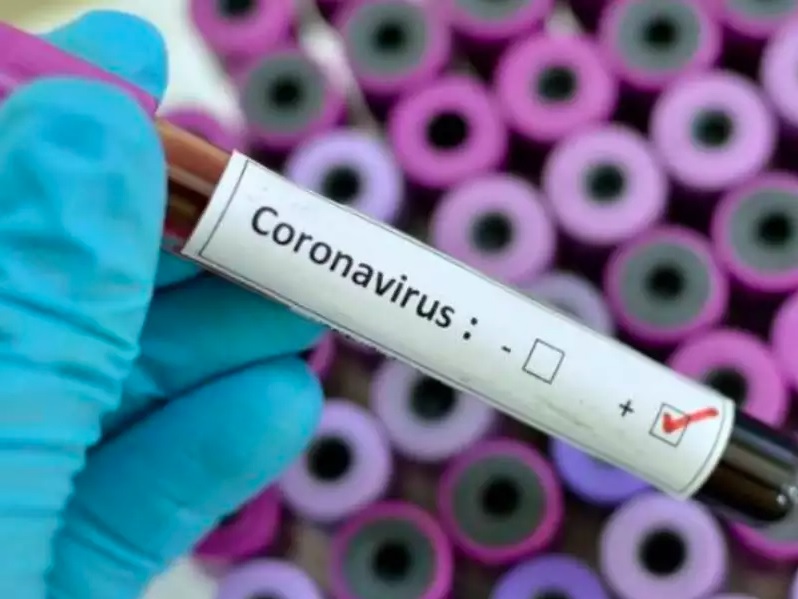
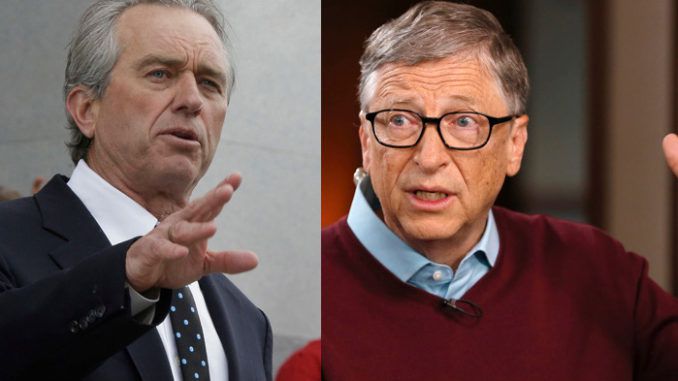
Bill Gates and the Depopulation Agenda. Robert F. Kennedy Junior Calls for an Investigation

For over twenty years Bill Gates and his Foundation, the Bill and Melinda Gates Foundation (BMGF) have been vaccinating foremost children by the millions in remote areas of poor countries, mostly Africa and Asia. Most of their vaccination program had disastrous results, causing the very illness and sterilizing young women . Many of the children died. Many of the programs were carried out with the backing of the WHO and – yes – the UN Agency responsible for the Protection of Children, UNICEF. 

Most of these vaccination campaigns were implemented without the informed-consent of the children, parents, guardians or teachers, nor with the informed-consent, or with forged consent, of the respective government authorities. In the aftermath, The Gates Foundation was sued by governments around the world, Kenya, India, the Philippines – and more.

Bill Gates has a strange image of himself. He sees himself as The Messiah who saves the world through vaccination – and through population reduction.

Around the time, when the 2010 Rockefeller Report was issued, with its even more infamous “Lock Step” Scenario, precisely the scenario of which we are living the beginning right now, Bill Gates talked on a TED show in California, “Innovating to Zero” about the use of energy.

Is starting to feel like it’s every man for himself, Is possible that right now, a global crisis is upon us, Without even knowing… And the virus may not be the biggest threat, but the crisis that follows, Everyday goods that keep us alive will be gone, I’m talking, food, fresh water, medicine, clothes, fuel…

He used this TED presentation to promote his vaccination programs, literally saying, “If we are doing a real good job vaccinating childen, we can reduce the world population by 10% to 15%”.

This sounds very much like eugenics.

The video, the first 6’45”, “The Truth about Bill Gates and his Disastrous Vaccination Program”, will tell you all about it.

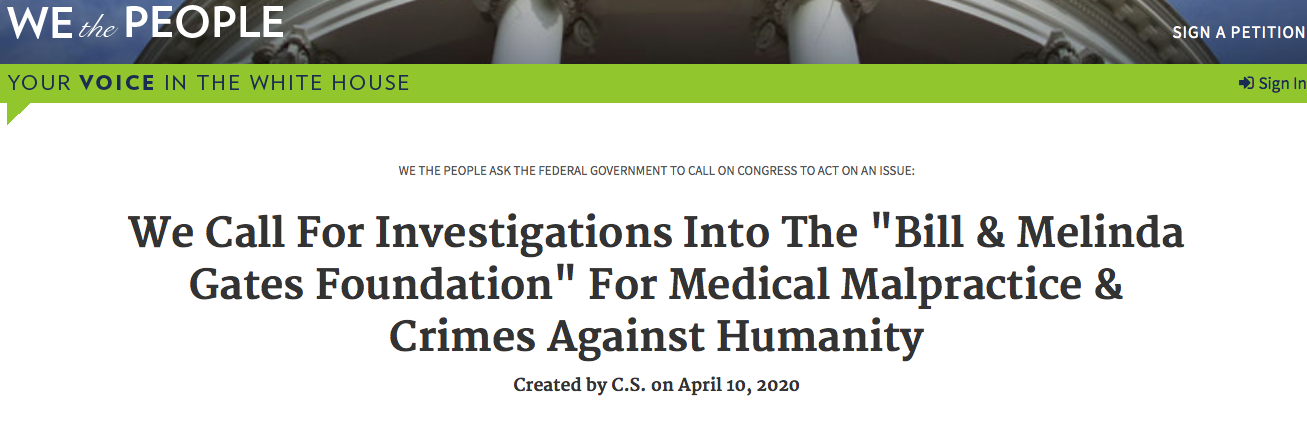
Robert F Kennedy Jr, an avid Defender of Children’s Rights and anti-vaccination activist, has launched a petition sent to the White House, calling for “Investigations into the ‘Bill and Melinda Gates Foundation’ for Medical Malpractice & Crimes Against Humanity

Screenshot 

“At the forefront of this is Bill Gates, who has publicly stated his interest in “reducing population growth” by 10-15%, by means of vaccination. Gates, UNICEF & WHO have already been credibly accused of intentionally sterilizing Kenyan children through the use of a hidden HCG antigen in tetanus vaccines”. (Excerpt from text of Petition)

Link to the Petition.

If you wish to Sign the Petition click Here  

(At the time of writing, the petition had over 265,000. It requires 100,000 for an answer from the White House)

Video: Robert F. Kennedy Junior

See also brief video featuring Author Bill Still ( 6 min) entitled The Truth about Bill Gates and his disastrous Vaccination Programs around the World

Robert. F. Kennedy Exposes Bill Gates’ Vaccination Agenda

Now Mr. Gates and his allies, including Big-Pharma, WHO, UNICEF, Dr. Anthony Fauci, Director of NIAID / NIH, a close ally of Mr. Gates  – and of course, Agenda ID2020, are proposing to (force) vaccinate 7 billion people around the globe, with their concoction of a (so far) untested coronavirus vaccine. This is a multi-billion dollar bonanza for  Big Pharma and for all those who support the vaccine. Nobody will really know what the vaccine cocktail will contain. 

Mind you, there is no need for a vaccine to cure the corona virus. There are many cures:

French Professor Didier Raoult, who is one of the world’s top 5 scientists on communicable diseases, suggested the use of hydroxychloroquine (Chloroquine or Plaquenil), a well-known, simple, and inexpensive drug, also used to fight Malaria, and that has shown efficacy with previous coronaviruses such as SARS.  By mid-February 2020, clinical trials at his institute and in China already confirmed that the drug could reduce the viral load and bring spectacular improvement. Chinese scientists published their first trials on more than 100 patients and announced that the Chinese National Health Commission would recommend Chloroquine in their new guidelines to treat Covid-19. (Peter Koenig, April 1, 2020)

Be aware, awake, alert and warned.

The Centers for Disease Control and Prevention now recommends wearing personal protective equipment (PPE) masks in public settings to help slow the spread of COVID-19.

Get the same 95% efficiency as health-care workers without depleting the N95 supply. Ships same day from the U.S. Support

These obscure individuals who pretend running our world have never been elected. We don’t need to name them. They are a forefront for the Beast. But they have the same objective: A New or One World Order (NWO, or OWO)

Aldous Huxley’s Brave New World and George Orwell’s 1984. Plan or Prophecy

Imagine, you are living in a world that you are told is a democracy – and you may even believe it – but in fact your life and fate is in the hands of a few ultra-rich, ultra-powerful and ultra-inhuman oligarchs. They may be called Deep State, or simply the Beast, or anything else obscure or untraceable – it doesn’t matter. They are less than the 0.0001%.

For lack of a better expression, let’s call them for now “obscure individuals”. 

These obscure individuals who pretend running our world have never been elected. We don’t need to name them. You will figure out who they are, and why they are famous, and some of them totally invisible. They have created structures, or organisms without any legal format. They are fully out of international legality. They are a forefront for the Beast. Maybe there are several competing Beasts. But they have the same objective: A New or One World Order (NWO, or OWO).

These obscure individuals are running, for example, The World Economic Forum (WEF – representing Big Industry, Big Finance and Big Fame), the Group of 7 – G7, the Group of 20 – G20 (the leaders of the economically” strongest” nations). There are also some lesser entities, called the Bilderberg Society, the Council on Foreign Relations (CFR), Chatham House and more.

The members of all of them are overlapping. Even this expanded forefront combined represents less than 0.001%. They all have superimposed themselves over sovereign national elected and constitutional governments, and over THE multinational world body, the United Nations, the UN.

In fact, they have coopted the UN to do their bidding. UN Director Generals, as well as the DGs of the multiple UN-suborganizations, are chosen  mostly by the US, with the consenting nod of their European vassals – according to the candidate’s political and psychological profile. If his or her ‘performance’ as head of the UN or head of one of the UN suborganizations fails, his or her days are counted. Coopted or created by the Beast(s) are also, the European Union, the Bretton Woods Organizations, World Bank and IMF, as well as the World Trade Organization (WTO) – and – make no mistake – the International Criminal Court (ICC) in The Hague. It has no teeth. Just to make sure the law is always on the side of the lawless.

In addition to the key international financial institutions, WB and IMF, there are the so-called regional development banks and similar financial institutions, keeping the countries of their respective regions in check.

In the end its financial or debt-economy that controls everything. Western neoliberal banditry has created a system, where political disobedience can be punished by economic oppression or outright theft of national assets in international territories. The system’s common denominator is the (still) omnipresent US-dollar.

“Unelected Individuals”

The supremacy of these obscure unelected individuals becomes ever more exposed. We, the People consider it “normal” that they call the shots, not what we call – or once were proud of calling, our sovereign nations and sovereignly elected governments. They have become a herd of obedient sheep. The Beast has gradually and quietly taken over. We haven’t noticed. It’s the salami tactic: You cut off slice by tiny slice and when the salami is gone, you realize that you have nothing left, that your freedom, your civil and human rights are gone. By then it’s too late. Case in point is the US Patriot Act. It was prepared way before 9/11. Once 9/11 “happened”, the Patriot Legislation was whizzed through Congress in no time – for the people’s future protection – people called for it for fear – and – bingo, the Patriot Act took about 90% of the American population’s freedom and civil rights away. For good.

We have become enslaved to the Beast. The Beast calls the shots on boom or bust of our economies, on who should be shackled by debt, when and where a pandemic should break out, and on the conditions of surviving the pandemic, for example, social confinement. And to top it all off – the instruments the Beast uses, very cleverly, are a tiny-tiny invisible enemy, called a virus, and a huge but also invisible monster, called FEAR. That keeps us off the street, off reunions with our friends, and off our social entertainment, theatre, sports, or a picnic in the park.

Soon the Beast will decide who will live and who will die, literally – if we let it. This may be not far away. Another wave of pandemic and people may beg, yell and scream for a vaccine, for their death knell, and for the super bonanza of Big Pharma – and towards the objectives of the eugenicists blatantly roaming the world – see this. There is still time to collectively say NO. Collectively and solidarily.

Take the latest case of blatant imposture. Conveniently, after the first wave of Covid-19 had passed, at least in the Global North, where the major world decisions are made, in early June 2020, the unelected WEF Chairman, Klaus Schwab, announced “The Great Reset”. Taking advantage of the economic collapse – the crisis shock, as in “The Shock Doctrine” – Mr. Schwab, one of the Beast’s frontrunners, announces openly what the WEF will discuss and decide for the world-to-come in their next Davos Forum in January 2021. For more details see this.

Will, We, The People, accept the agenda of the unelected WEF?

It will opportunely focus on the protection of what’s left of Mother Earth; obviously at the center will be man-made CO2-based “Global Warming”. The instrument for that protection of nature and humankind will be the UN Agenda 2030 – which equals the UN Sustainable Development Goals (SDG). It will focus on how to rebuild the willfully destroyed global economy, while respecting the (“green”) principles of the 17 SDGs.

Mind you, it’s all connected. There are no coincidences. The infamous Agenda 2021 which coincides with and complements the so-called (UN) Agenda 2030, will be duly inaugurated by the WEF’s official declaration of The Great Reset, in January 2021. Similarly, the implementation of the agenda of The Great Reset began in January 2020, by the launch of the corona pandemic – planned for decades with the latest visible events being the 2010 Rockefeller Report with its “Lockstep Scenario”, and Event 201, of 18 October in NYC which computer-simulated a corona pandemic, leaving within 18 months 65 million deaths and an economy in ruin, programmed just a few weeks before the launch of the actual corona pandemic.

The Race Riots

The racial riots, initiated by the movement Black Lives Matter (funded by the Ford Foundation and Soros’ Open Society Foundation), following the brutal assassination of the Afro-American George Floyd by a gang of Minneapolis police, and spreading like brush-fire in no time to more than 160 cities, first in the US, then in Europe – are not only connected to the Beast’s agenda, but they were a convenient deviation from the human catastrophe left behind by Covid-19. See also this.

The Beast’s nefarious plan to implement what’s really behind the UN Agenda 2030 is the little heard-of Agenda ID2020.  It has been created and funded by the vaccination guru Bill Gates, and so has GAVI (Global Alliance for Vaccines and Immunizations), the association of Big Pharma – involved in creating the corona vaccines, and which funds along with the Bill and Melinda Gates Foundation (BMGF) a major proportion of WHO’s budget.

The Great Reset, as announced by WEF’s Klaus Schwab, is supposedly implemented by Agenda ID2020. It is more than meets the eye. Agenda ID2020 is even anchored in the SDGs, as SDG 16.9 “by 2030 provide legal [digital] identity for all, including free birth registration”. This fits perfectly into the overall goal of SDG 16: 

Following the official path of the UN Agenda 2030 of achieving the SDGs, the ‘implementing’ Agenda ID2020 – which is currently being tested on school children in Bangladesh – will provide digitized IDs possibly in the form of nano-chips implanted along with compulsory vaccination programs, will promote digitization of money and the rolling out of 5G – which would be needed to upload and monitor personal data on the nano chips and to control the populace. Agenda ID2020 will most likely also include ‘programs’ – through vaccination? – of significantly reducing world population. Eugenics is an important component in the control of future world population under a NOW / OWO – see also Georgia Guidestones, mysteriously built in 1980.

The ruling elite used the lockdown as an instrument to carry out this agenda. Its implementation would naturally face massive protests, organized and funded along the same lines as were the BLM protests and demonstrations. They may not be peaceful – and may not be planned as being peaceful. Because to control the population in the US and in Europe, where most of the civil unrest would be expected, a total militarization of the people is required. This is well under preparation.

In his essay “The Big Plantation”, John Steppling reports from a NYT article that a

“minimum of  93,763 machine guns, 180,718 magazine cartridges, hundreds of silencers and an unknown number of grenade launchers have been provided to state and local police departments in the US since 2006. This is in addition to at least 533 planes and helicopters, and 432 MRAPs — 9-foot high, 30-ton Mine-Resistant Ambush Protected armored vehicles with gun turrets and more than 44,900 pieces of night vision equipment, regularly used in nighttime raids in Afghanistan and Iraq.”

He adds that this militarization is part of a broader trend. Since the late 1990s, about 89 percent of police departments in the United States serving populations of 50,000 people or more had a PPU (Police Paramilitary Unit), almost double of what existed in the mid-1980s. He refers to these militarized police as the new Gestapo.

Even before Covid, about 15% to 20% of the population was on or below the poverty line in the United States. The post-covid lockdown economic annihilation will at least double that percentage – and commensurately increase the risk for civil turbulence and clashes with authorities – further enhancing the reasoning for a militarized police force.

China’s Crypto RMB

None of these scenarios will, of course, be presented to the public by the WEF in January 2021. These are decisions taken behind closed doors by the key actors for the Beast. However, this grandiose plan of the Great Reset does not have to happen. There is at least half the world population and some of the most powerful countries, economically and militarily – like China and Russia – opposed to it. “Reset” maybe yes, but not in these western terms. In fact, a reset of kinds is already happening with China about to roll out a new People’s Bank of China backed blockchain-based cryptocurrency, the crypto RMB, or yuan. This is not only a hard currency based on a solid economy, it is also supported by gold.

While President Trump keeps trashing China for unfair trade, for improperly managing the covid pandemic, for stealing property rights – China bashing no end – that China depends on the US and that the US will cut trading ties with China – or cut ties altogether, China is calling Trump’s bluff. China is quietly reorienting herself towards the ASEAN countries plus Japan (yes, Japan!) and South Korea, where trade already today accounts for about 15% of all China’s trade and is expected to double in the next five years.

Despite the lockdown and the disruption of trade, China’s overall exports recovered with a 3.2% increase in April (in relation to April 2019). This overall performance in China exports was nonetheless accompanied by a dramatic decline in US-China trade. China exports to the US decreased by 7.9% in April (in relation to April 2019).

It is clear that the vast majority of US industries could not survive without Chinese supply chains. The western dependence on Chinese medical supplies is particularly strong. Let alone Chinese dependence by US consumers. In 2019, US total consumption, about 70% of GDP, amounted to $13.3 trillion, of which a fair amount is directly imported from China or dependent on ingredients from China.

The WEF-masters are confronted with a real dilemma. Their plan depends very much on the dollar supremacy which would continue to allow dishing out sanctions and confiscating assets from those countries opposing US rule; a dollar-hegemony which would allow imposing the components of The Great Reset scheme, as described above.

At present, the dollar is fiat money, debt-money created from thin air. It has no backing whatsoever. Therefore, its worth as a reserve currency is increasingly decaying, especially vis-à-vis the new crypto-yuan from China. In order to compete with the Chinese yuan, the US Government would have to move away from its monetary Ponzi-scheme, by separating itself from the 1913 Federal Reserve Act and print her own US-economy- and possibly gold-backed (crypto) money – not fiat FED-money, as is the case today. That would mean cutting the more than 100-year old ties to the Rothschild and Co. clan-owned FED, and creating a real peoples-owned central bank. Not impossible, but highly improbable. Here, two Beasts might clash, as world power is at stake.

Meanwhile, China, with her philosophy of endless creation would continue forging ahead unstoppably with her mammoth socioeconomic development plan of the 21st Century, the Belt and Road Initiative, connecting and bridging the world with infrastructure for land and maritime transport, with joint research and industrial projects, cultural exchanges – and not least, multinational trade with “win-win” characteristics, equality for all partners – towards a multi-polar world, towards a world with a common future for mankind.

Today already more than 120 countries are associated with BRI – and the field is wide open for others to join – and to defy, unmask and unplug The Great Reset of the West.

Coronavirus and the Constitution: We’re Allowing Authority To Dictate Reality, And Furthermore Our Every Movement.


Three months have passed since the lockdown began, and statistics indicate that the coronavirus death toll hasn’t risen as high as we might have supposed. Yet already we hear rhetoric of a “post-COVID world,” hauntingly reminiscent of the “post-9/11 world.” However, unlike the tangible event of 9/11, COVID is a threat of an entirely different nature, an “invisible enemy.”

The enemy isn’t “out there” to defeat in the old-fashioned way, with bombs and machine guns. But all the same, its pervasiveness renders us into a constant state of paranoia. Even our loved ones become potential threats; we all pose a risk to those around us, therefore perpetrating the omnipresent danger.

To use the post-9/11 term, we are all terrorists. That’s why we must stay under house arrest until a treatment is produced to save us from ourselves. The alphabet agencies even gave us a script: we’re supposed to play the part of Sleeping Beauty as we await Prince Charming’s cure for our mysterious ailment.

But the problem with fairytales is they fall apart under scrutiny; we struggle to believe in the knight in shining armor because experience has taught us again and again that he doesn’t exist.

So it is with tales spun by government officials. The real Sleeping Beauty still needs to pay the bills, and a check of $1200 simply won’t do. She doesn’t have time to wait around for Bill Gates to unveil the miracle vaccine.

And by the time he does, who will still believe the fairytale? As fatalities continue not to skyrocket and hospitals are underwhelmed, life goes on….Everyday events begin to overshadow media induced hysteria. The spell breaks; the masquerade ends.

Yet the question remains: will the sociopolitical climate restabilize after the invisible enemy’s defeat? We’ve entered a Brave New Normal, we are repeatedly told. Life so eerily resembles the flick Contagion that we might be tempted to fast-forward and spoil the ending.

Is the final solution portrayed there a realistic possibility? Imagine — a cashless economy (since cash is germ-ridden), centralized global government, and militarized police force guiding the frightened masses like shepherds watching over their flock! The CDC’s contribution to that particular film production suggests they think it could solve the problem. The cure therefore must not only be physical, but socioeconomic.

So, suddenly the government cares more intensely about citizen health than most citizens care about their own health. The TRACE Act permits contact tracers to keep an eye on whether we’ve crossed paths with the invisible enemy; with Operation Warp Speed, troops will administer vaccines door to door.

But all of this reveals the patronizing mindset of our benevolent shepherds. We are no longer to trust our own research and direct experience — after all, unlike other flus, this one has the curious tendency of manifesting no symptoms. Instead we are to place our wellbeing into the hands of contact tracers, the WHO, the military, anyone other than ourselves.

In other words, we’re allowing authority to dictate reality, and furthermore our every movement.

But if we ignore all of this and go about our business, aren’t we at risk of spreading The Virus? Doubtfully — but if we allow the Naziesque strategies of “flattening the curve” to escalate, we certainly put our liberties at risk. Our Constitutional rights — freedom of speech, religion, and assembly to name a few — have come under fire behind the veneer of “health and safety” measures against the seemingly almighty Virus.

Meanwhile, many of us suspect that if we defend our God-given rights, the invisible enemy will fade like smoke — or like any other virus.